

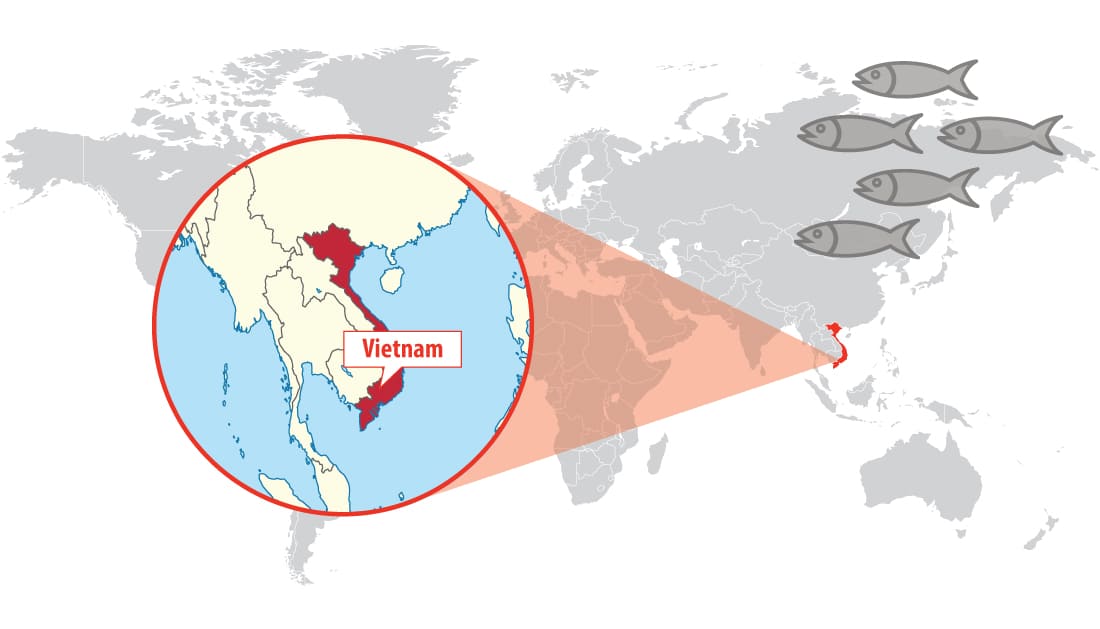
Overview
Vietnam is one of the main worldwide fish producers and exporters. Its annual fish production is approximately 5,699,250 tons, representing an export value of 1.7 billion USD. The main markets are Europe, USA, Mexico, and China. The European Union has already warned wholesalers to establish tougher control measures on fish quality and farming conditions.
Thanh Bình District, Dong Thap Province, Vietnam
Project Overview
PHA Distribution, a leading IoT & ICT distributor in Vietnam, deployed a wireless sensor network at a fish farm in Thanh Bình District, Dong Thap Province, near the Mekong River, using Libelium’s Waspmote Plug & Sense! Sensor Platform. The project monitors real-time parameters to control water quality and prevent diseases that could affect fish, improving both the quality and quantity of production. This enhances water quality in fish farming and supports healthier stock.
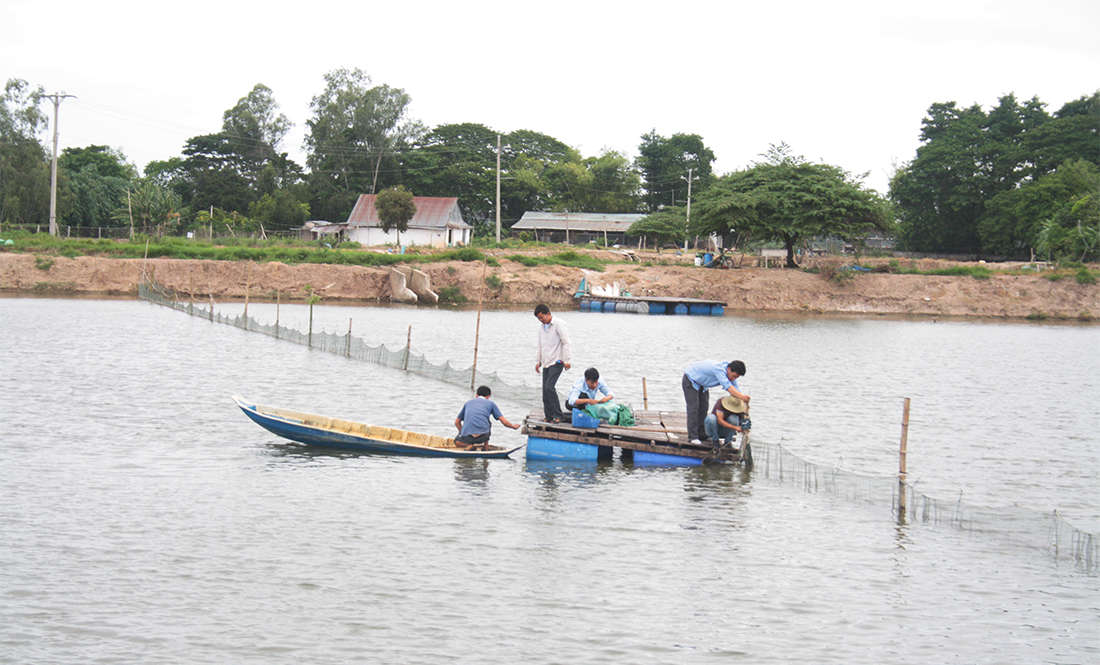
Waspmote Plug & Sense! intallation in a fish farm pond
Goals and Rationale
The deployment emphasizes monitoring fish farm pond conditions to react quickly to environmental changes.
Real-time Monitoring to Improve Production
Tran Vinh Phong, Managing Director at PHA Distribution, states: “Real-time monitoring will allow us to help our end clients to be aware of preventable diseases in order to save costs in diseases treatment and keep fish in good health before harvesting job as well as manage fish loss to the minimum rate.”
The company chose Libelium’s Waspmote Plug & Sense! Sensors Platform because the hardware has a good design, is easy to implement, scalable depending on demand, and has low maintenance costs.
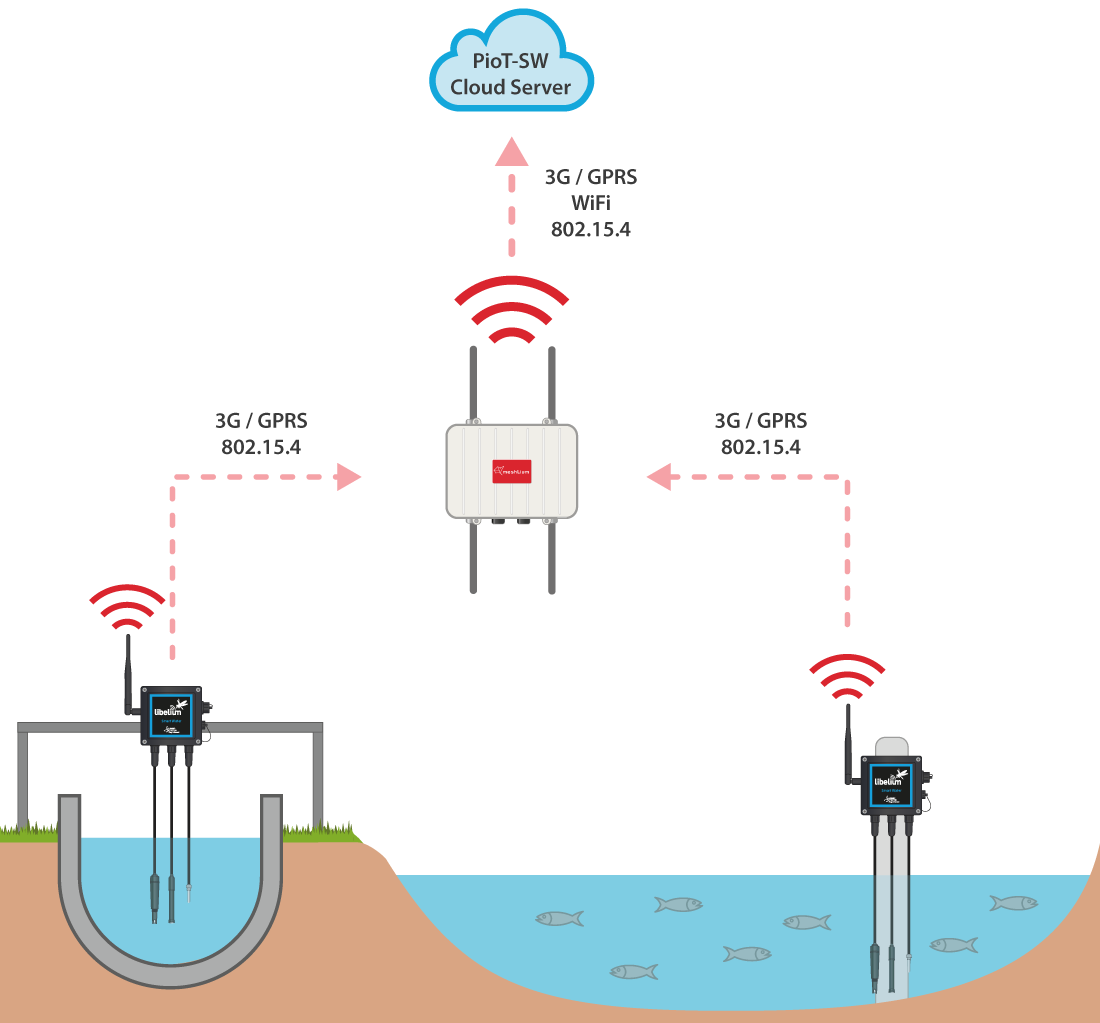
Fish farm deployment functioning diagram
System Architecture
Parameters Monitored
Waspmote Plug & Sense! Smart Water has been deployed at the water source and inside the fish farm. Water and fish quality are monitored through the following parameters:
- Temperature
- Conductivity
- Dissolved Oxygen (DO)
- Oxidation-Reduction Potential (ORP)
Power Supply
Because supplying grid electricity to pond nodes is difficult, each node includes a solar panel and a battery to ensure a continuous energy supply.
Future Expansion
In a second project phase, Waspmote Plug & Sense! Smart Water Ions will be installed to monitor:
- Ammonium Ion (NH4)
- Nitrate Ion (NO3)
- Nitrite Ion (NO2)
These are key indicators of toxicity created by fish feces.
Communications and Cloud Platform
Waspmote Plug & Sense! Sensors Platforms communicate with the Meshlium Gateway via 3G/GPRS and 802.15.4. Meshlium sends collected data to the cloud using 3G, 802.15.4, and WiFi. The visualization platform is PHA Distribution’s cloud-based application, PioT-SW, which enables real-time parameter control and diagrams showing their evolution.
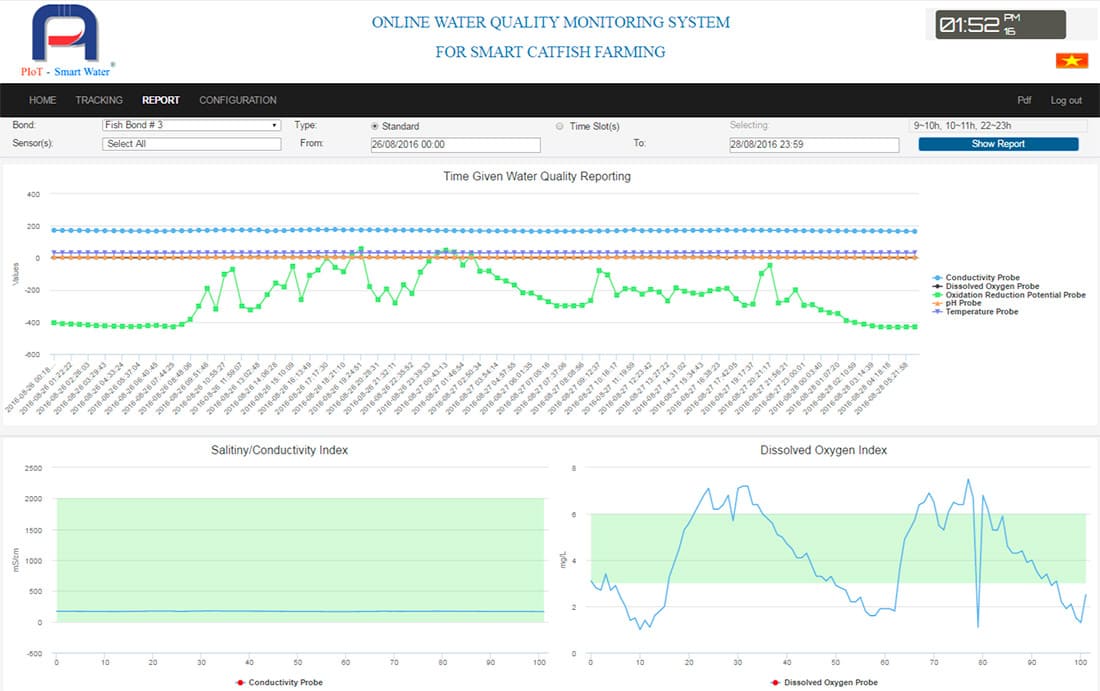
Pha Distribution Application
Expected Impact and ROI
Less Fish and Money Losses
In a 5,000 m² pond, 4 meters deep, 2,000 kilos of juvenile fish are stocked. After six months, approximately 30,000 kilos of adult fish are harvested at a price of 1.50 USD per kilo. Product losses are about 40% in number of animals, usually due to preventable diseases that can be avoided with proper water quality control.
Real-time monitoring could reduce animal losses by 40–50%, allowing harvests of roughly 38,000–40,000 kilos instead of 30,000 kilos with the same number of juvenile fish. The difference in turnover would be at least 12,000 USD every six months per farm.
Broader Applications and Compliance
“It’s not only potential in fish farming but also for shrimp farming as there they need to monitor DO & pH parameters including ORP beside others to ensure their supply water quality as well as monitor shrimp’s growth life-cycle successfully,” notes Tran Vinh Phong.
Water quality monitoring is essential to meet international regulations that assure water quality in fish farming, fish quality, and farming conditions. Fish farm facilities can demonstrate that companies have implemented new systems, placing them in stronger commercial positions than those still using traditional methods.