

Climate emergency management: better anticipation starts with understanding the territory
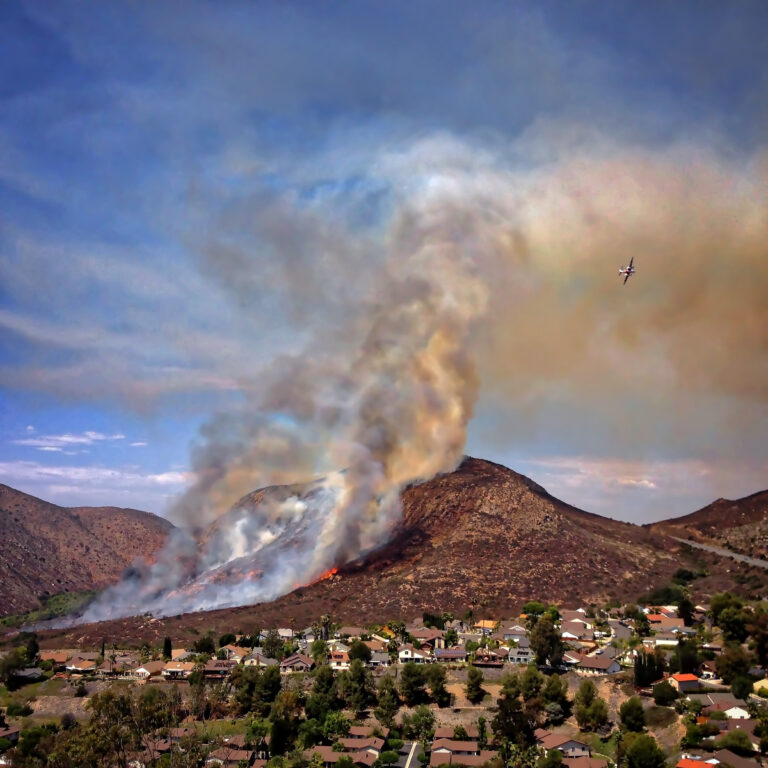
How environmental monitoring, territorial data, geospatial intelligence and alert systems can help anticipate climate risks and...

Combine soil, plant and weather data in iris360 to understand crop conditions, optimise irrigation and identify risks before they affect yield or quality.
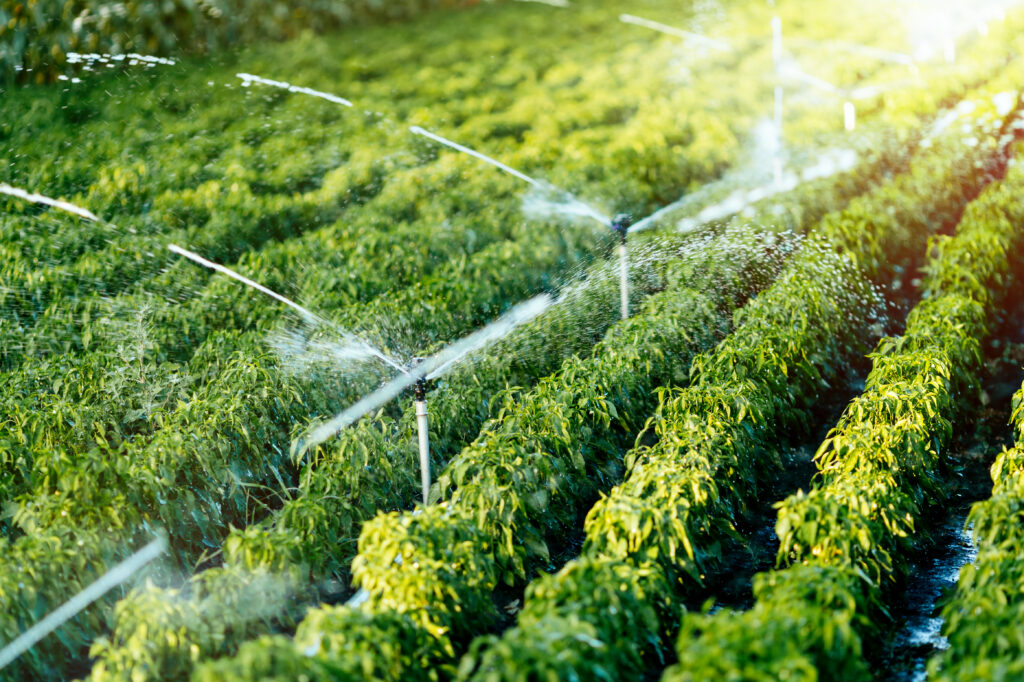
The global food system faces the challenge of feeding a population that could approach 10 billion people by 2050. This calls for using irrigation water more precisely and controlling gas emissions from livestock.
An end-to-end continuous data pipeline connecting field sensors, microclimate models, and automated irrigation management.
Soil, plant and weather sensors continuously capture field conditions.
iris360 contextualises soil, crop and weather data together.
Models anticipate irrigation needs and early stress indicators.
Irrigation decisions and alerts reach the teams who manage the field.
Compare zones, varieties and seasons to refine practices over time.
Libelium One measures the most relevant agronomic parameters — soil moisture, conductivity, temperature and water potential — and feeds a control system that automatically adjusts irrigation to the needs of each plot.
A flexible monitoring node that brings soil, crop and weather data together. Libelium One Agriculture helps growers understand field conditions, use resources more efficiently and make better-informed decisions throughout the growing cycle.
Connect a compatible sensor and the node automatically identifies it and downloads the required configuration—no programming or manual driver installation needed.
Four interchangeable ports accept compatible Libelium One probes, making it possible to combine multiple parameters in a single monitoring point.
Integrated cellular connectivity and a global SIM send measurements directly to the Libelium platform, with no need to install a local gateway.
A weather-resistant enclosure, very low power consumption, a rechargeable battery and an optional solar panel enable monitoring at remote locations.
No results match your search.
Monitor soil water content, temperature, electrical conductivity, water potential and oxygen to understand the conditions affecting root development.
Compatible weather stations measure parameters such as rainfall, wind, air temperature, humidity, atmospheric pressure and solar radiation directly at crop level.
Leaf wetness, solar radiation and non-contact surface temperature sensors reveal conditions associated with disease risk, heat stress and crop development.
Multilevel probes provide moisture and conductivity readings across the soil profile, helping identify water movement and differences between root-zone layers.
No results match your search.
iris360 connects soil probes, weather and crop context to show where water is needed, support irrigation planning and highlight frost or fungal risk by block.
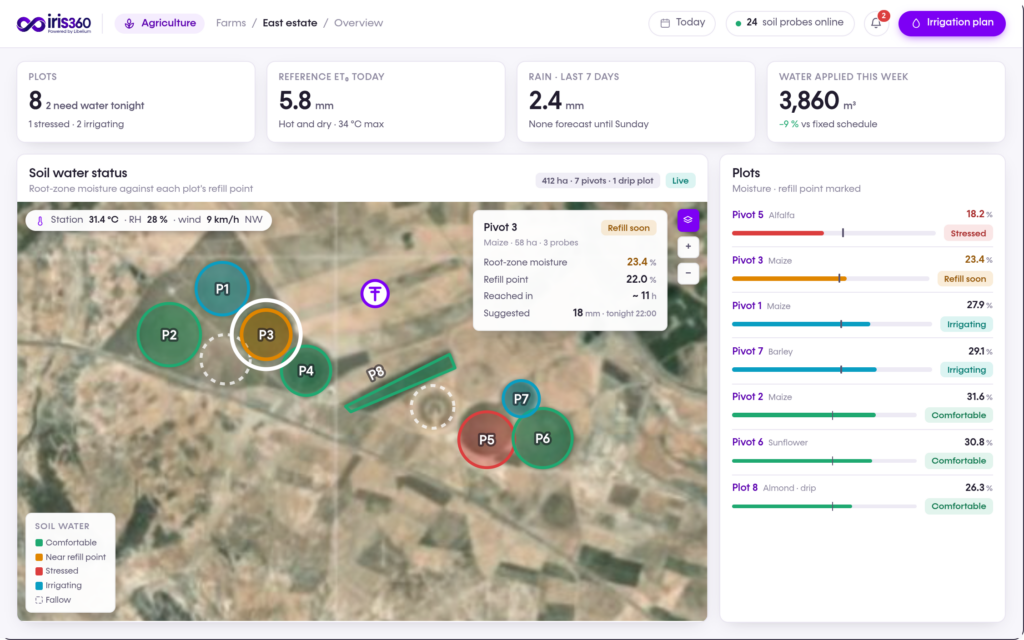
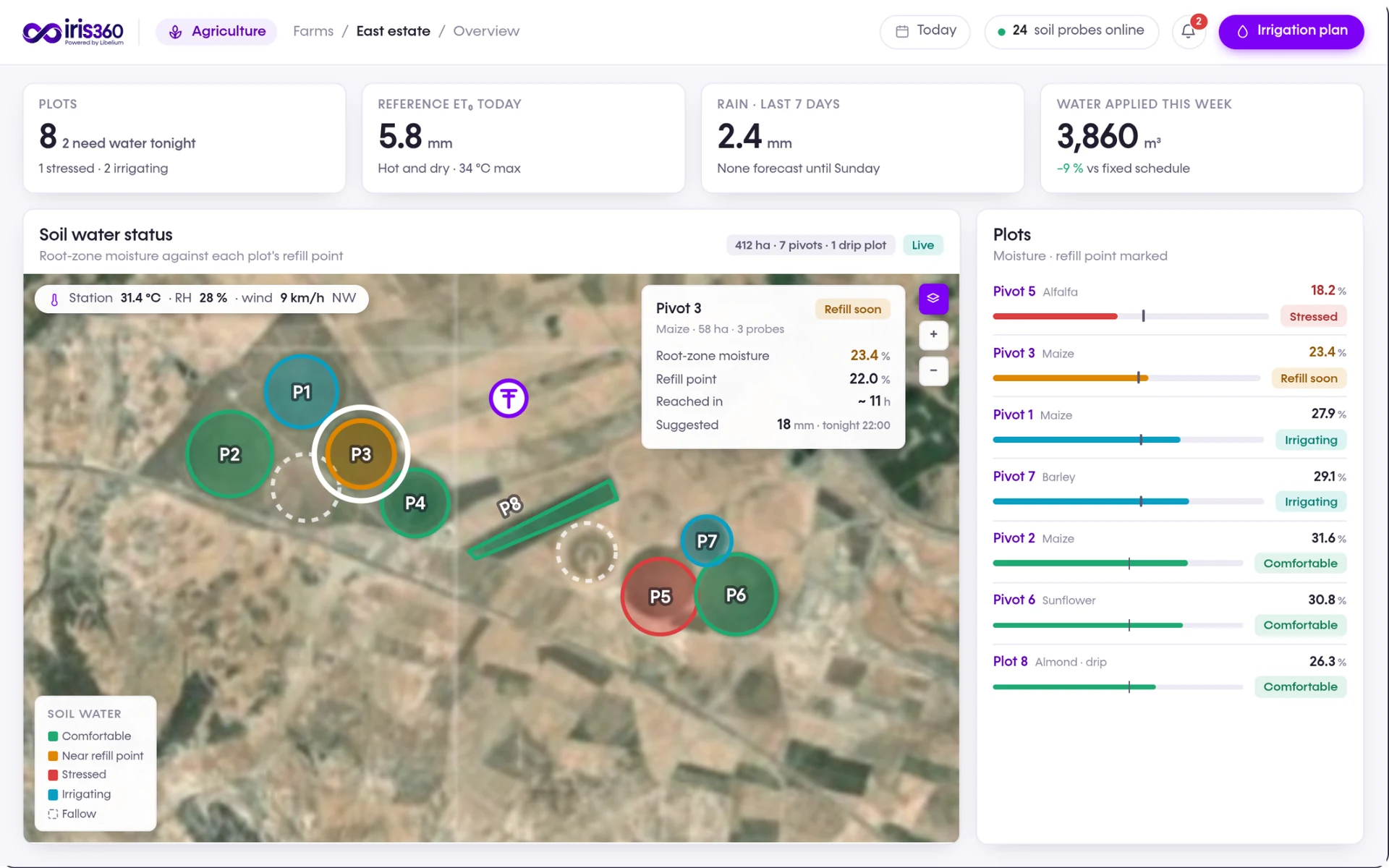
Plot Status
Bring soil moisture, refill points, weather and rainfall into a single farm view. Spot stressed plots, see which are being irrigated and prioritise those approaching their refill point.
Plot moisture status with weather, rainfall and irrigation indicators.
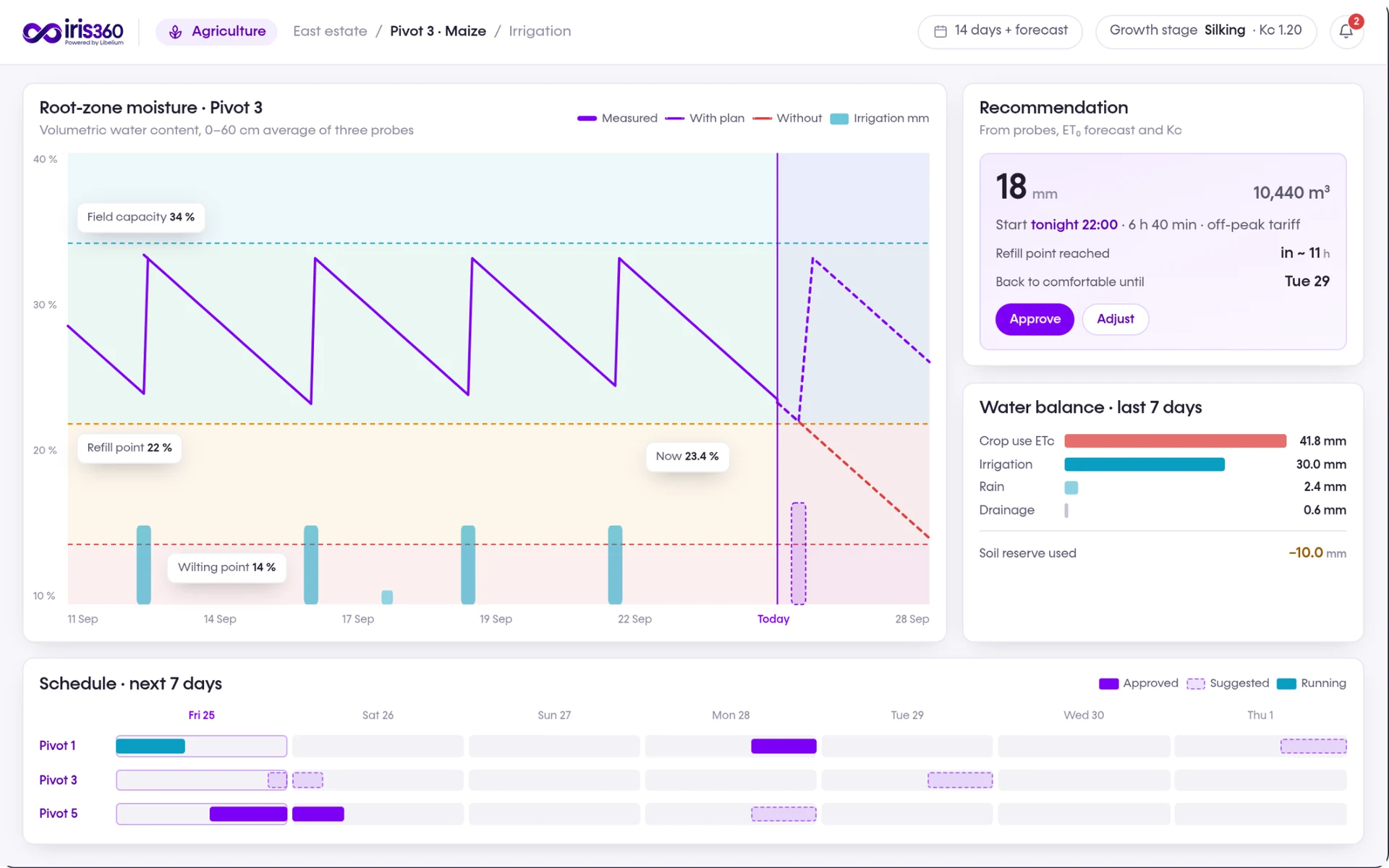
Irrigation Planning
Compare projected soil moisture with and without irrigation, review a recommendation informed by probes and crop demand, and approve or adjust the upcoming schedule.
Soil moisture projection, recommendation, water balance and schedule.
Crop Risk
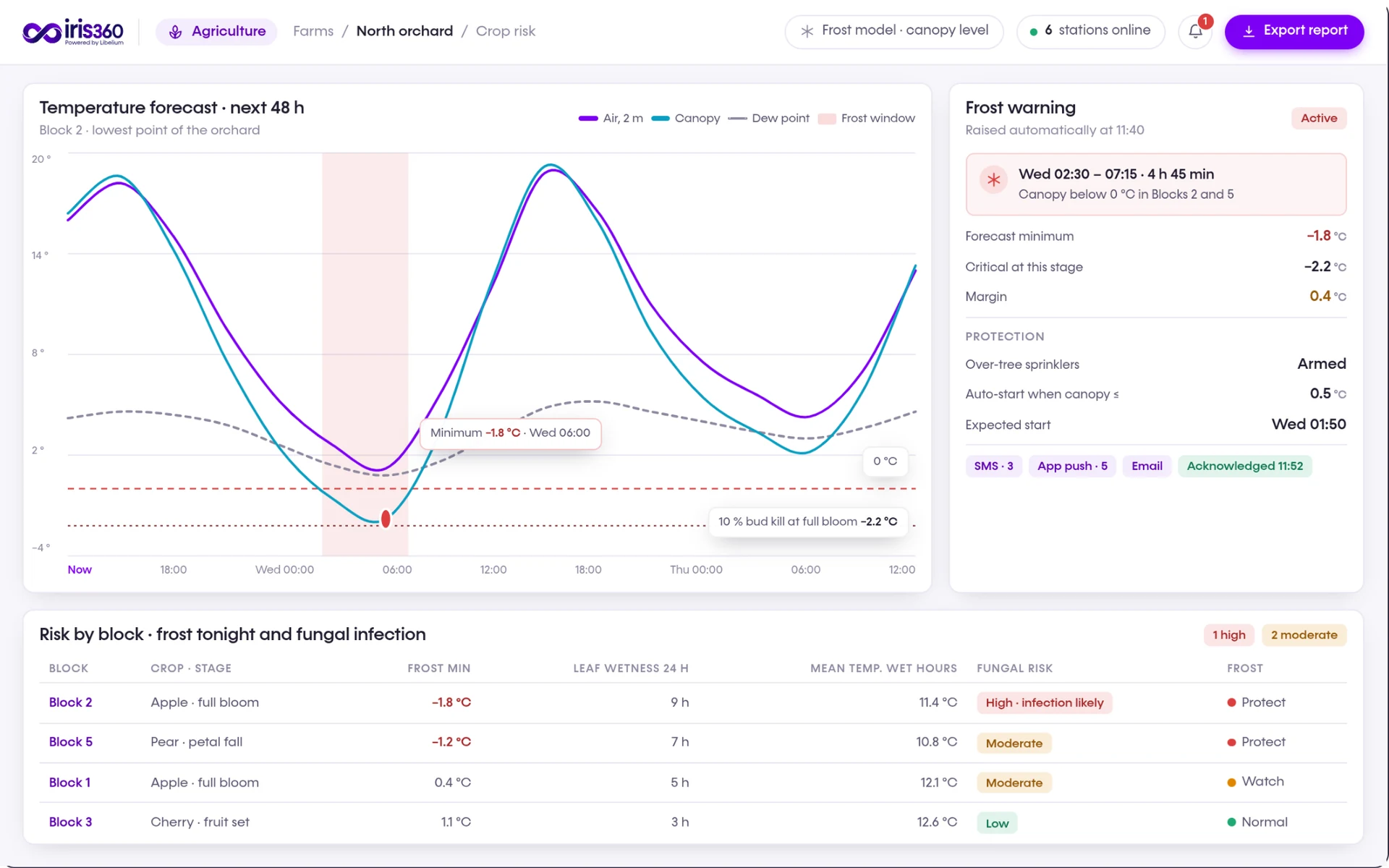
Combine temperature forecasts, canopy conditions, leaf wetness and crop stage to see which blocks may need protection, with alerts and protection status in one place.
Frost forecast and block-level fungal risk, with alerts and protection status.
turns field measurements and forecasts into clearer irrigation plans and timely crop-risk alerts.
Integrate your existing devices and sensors into iris360 using open FIWARE NGSI-LD models and REST and MQTT interfaces. Centralise your data in unified operational dashboards.
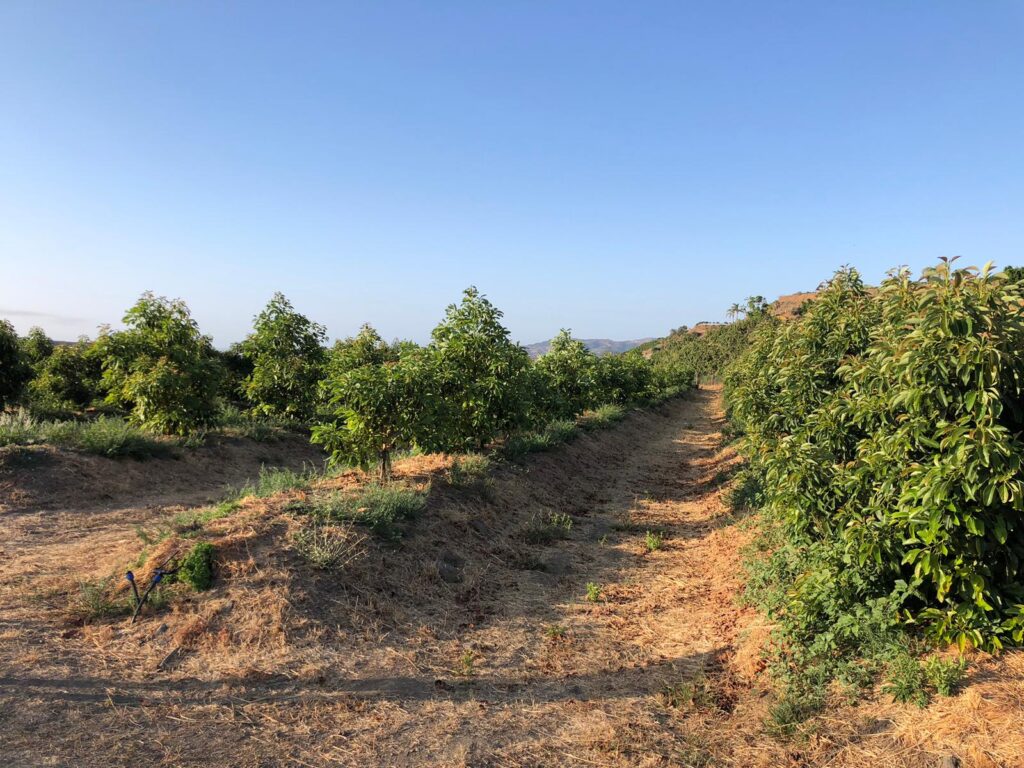
From open-field extensive crops and vineyards to intensive greenhouses and fruit orchards.
Dynamic scheduling based on real-time soil moisture, temperature and evapotranspiration data.
Early warning of water deficit, extreme temperature events, and phytosanitary risks.
Benchmark performance across multiple plots, farms, varieties and management zones.
Historical telemetry modeling to compare yield patterns across crop cycles and seasons.
ESG (environmental, social and governance) reporting to support sustainability and regulatory compliance monitoring in agriculture.
No results match your search.
Industrial sites and cities actively monitoring environmental impact with Libelium technology.
How environmental monitoring, territorial data, geospatial intelligence and alert systems can help anticipate climate risks and...
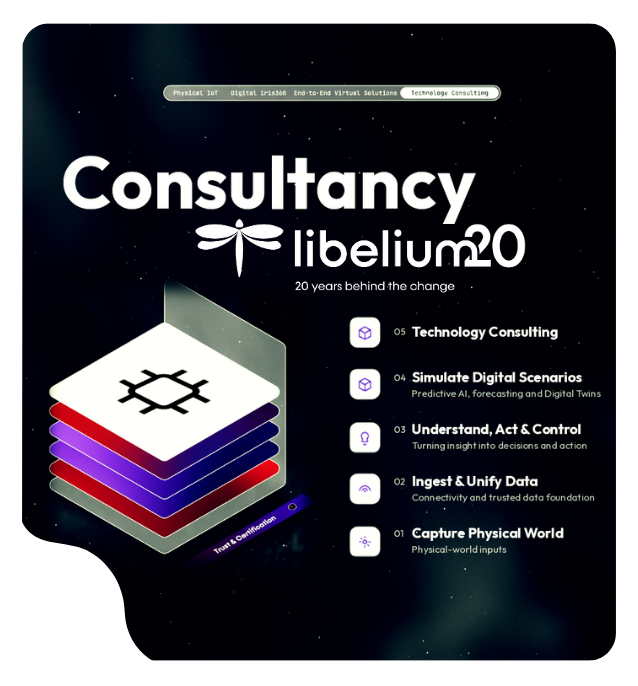
The spanish company evolves into a consultancy firm to shoulder greater responsibility on sustainable and sovereign...

Compare LoRaWAN and 4G in terms of power consumption, coverage, data volume, mobility and network control....

Discover how the Alhambra Living Lab, powered by AI and Libelium IoT sensors, revolutionizes the preservation...
Work with Libelium to design a scalable, interoperable and mission-critical solution adapted to your operations.