Indicative air quality station

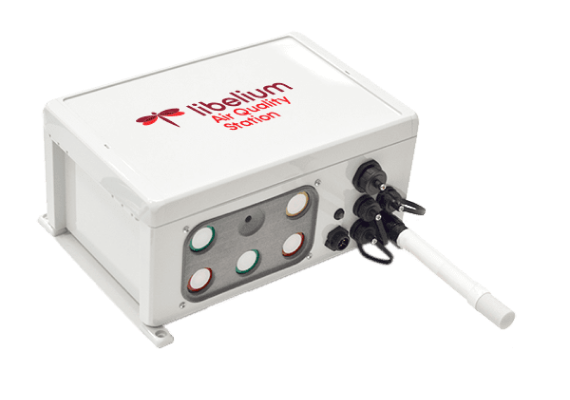
Air Quality Station. Precision sensing with Cloud AI calibration.

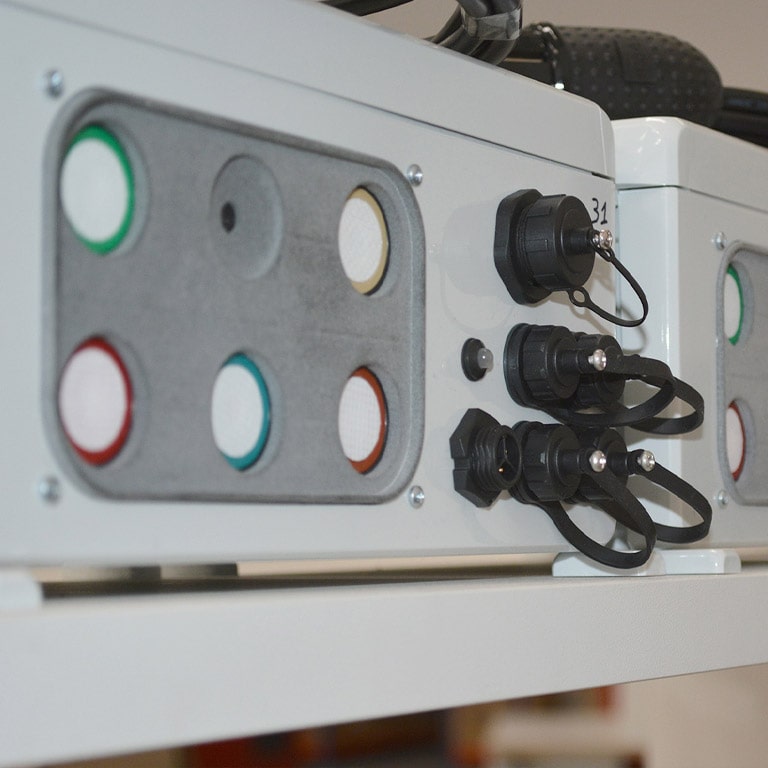
Designed to complement high-cost reference stations in urban centers and industrial perimeters, the Air Quality Station combines calibrated electrochemical gas sensors, optical particulate counters and ultrasonic weather monitoring with automated Machine Learning calibration.

SO2 · O3 · NO · NO2 · CO
Gases
PM1 · PM2.5 · PM10
Particulates
Machine learning
Algorithms applied
LTE (4G)
Radio

More granularity to measure AQI in the city

Cities require Reference Air Quality stations to monitor key pollution parameters. These stations have high costs and their size is significant.

A higher spatial granularity is needed with a much larger number of reference stations spread throughout the city.

Libelium can solve this by providing smarter Air Quality Stations that can be distributed in the key points of the smart city.

Air Quality City

AQI measurement solution

The new Air Quality Station has been designed to integrate Artificial Intelligence to create predictive models that you can manage through Libelium Cloud.


The quality of the reference data directly affects the results: good data range and resolution generate better A.I. models.

We make the difference

01

Granularity

Affordable, compact, and accurate stations, enabling deployment to cover more key areas of the city. The more monitored locations in the city, the faster the response can be. Allows for a wider range of deployment and capillarity.

02

Tests and results

Take a look at the most recent studies we published and discover how the trained algorithm lead us to get the best R² and MAE in the market. Check the results on the installations where the Air Quality Station has been deployed: Terrasa – Zaragoza (Roger de Flor) – Zaragoza (Jaime Ferrán).

03

Two options for calibration

To apply the Artificial Intelligence models, Air Quality Station needs to be calibrated first. We offer two types of calibration options: co-calibration against the nearest reference station, or calibration using the universal models provided by Libelium.

1. Parameters that can be measured

Air Quality Station allows you to measure the most relevant pollutants and key parameters required in every air quality project. With a simple configuration you can manage the data in real-time from Libelium Cloud.

Libelium Air Quality Station Parameters
Particulate matter
  • PM1
  • PM2.5
  • PM10
Gases
  • CO
  • NO2
  • NO
  • O3
  • SO2
Weather station
  • Wind and compass
  • Precipitation
  • Temperature
  • humidity and pressure
  • Solar radiation
Noise level
  • Class 2 soundmeter IEC 61672

2. The Air Quality Station that learns: types of calibration

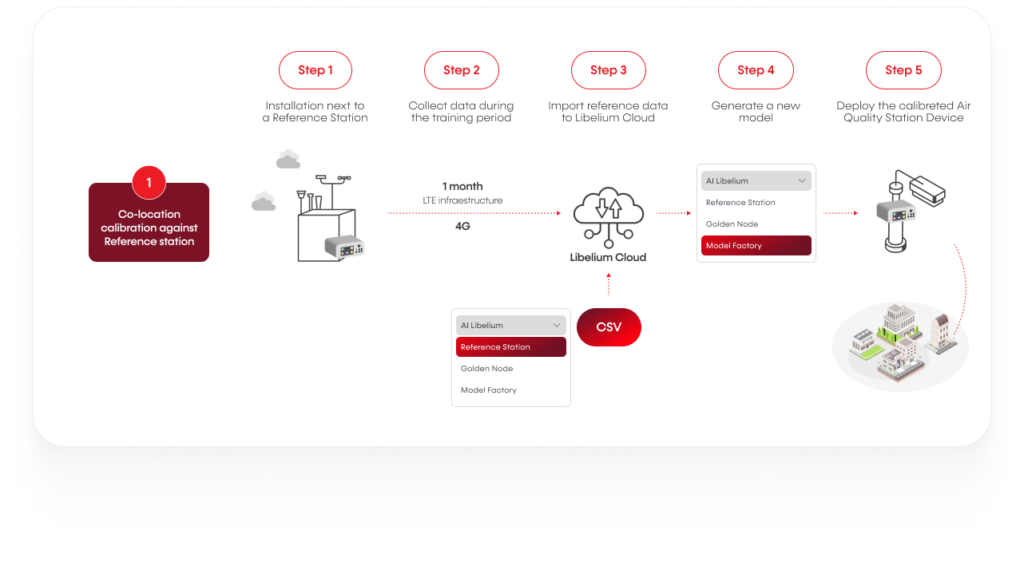
Co-location calibration against Reference Station

With this process you will obtain the most accurate results. You must get access to a reference station.

Step 1
Co-location phase: Air Quality Station will be deployed next to the reference station to collect data for 1 month. This is needed in order to calibrate Air Quality nodes against scientific reference stations.
Step 2-3
Data from the Reference station will be sent to Libelium Cloud through a CSV file. Meanwhile, all data gathered by Libelium Air Quality Station has been collected in the cloud.
Step 4
Then the calibration process starts in the Model Factory section from our Cloud. This is where Artificial Intelligence takes part, allowing the user to start predictive models.
Step 5
Once the AQS node has been calibrated and trained it is ready to be deployed. Remember that you can calibrate against the reference station more than one AQS node at the same time.

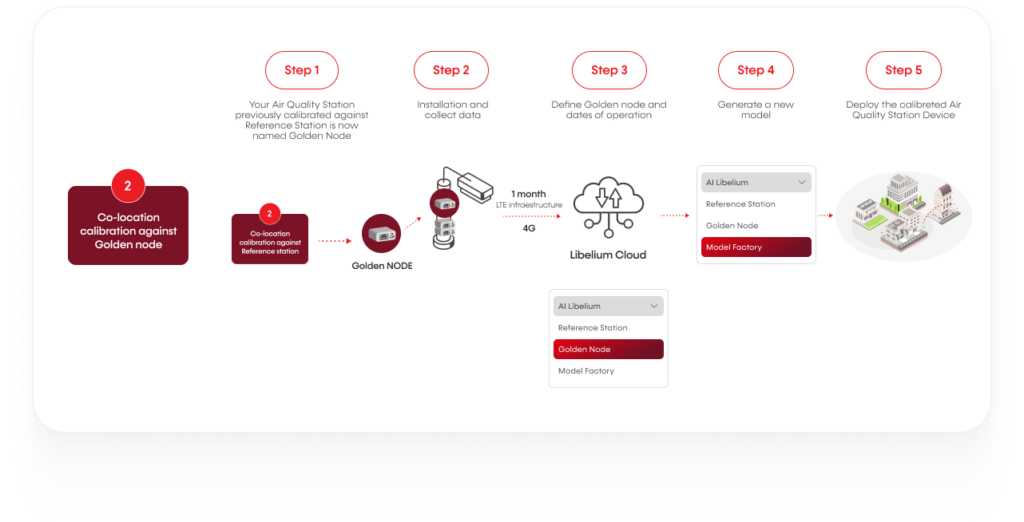
Calibration against Golden Node

This phase is interesting in case the project requires a large number of Air Quality Stations. In this way, it is possible to calibrate the remaining nodes with the node that was calibrated against the Reference Station in phase 1 (now called Golden Node). A “golden node” is an Air Quality Station node previously calibrated by co-location process. This means that a first “Co-location” phase must be completed prior defining the device as “golden node”.

Step 1
Co-location phase: Your Air Quality Station previously calibrated against Reference Station is now named Golden Node.
Step 2
Collect data during the training period
Step 3
Import reference data to Libelium Cloud.
Step 4
Generate a new model
Step 5
Deploy the calibrated Air Quality station device

Apply universal models: optimal accuracy with less effort

There are many barriers to accessing a reference station. That is why at Libelium we provide an alternative option for those users who do not have access to reference stations. The collected data layer from different locations analyzed in the recent studies allowed us the design of a generic artificial intelligence model for air quality prediction. Moreover, Libelium Air Quality Station’s universal model continues to learn and train itself from all Air Quality Stations deployed and placed next to reference stations, so it will become richer, more dynamic and more accurate.

Step 1
Different Libelium Air Quality Stations were deployed near Reference Stations and the collected data from the Reference stations will be sent to Libelium Cloud to shape the universal model.
Step 2
Now your Libelium Air Quality Station can work with the calibration against the universal model.

Air Quality Station Technical Information

3. Air Quality Station + Libelium Cloud

Data extracted from Scientific Reference Air Quality station is used in Artificial Intelligence (AI) model automation specifically for every project.

Libelium Cloud is the new software platform that allows the management of an IoT project from the beginning to the end.

4. Easy to use

Libelium Cloud allows the user to execute remote Over The Air Programming (OTA), parameter configuration and reboot via LTE network.

Air Quality Station Libelium Cloud
logo ministerio economia

Libelium participates in a project co-financed by the Spanish Ministry of Economy

Libelium participates in a project co-financed by the Spanish Ministry of the economy that promotes research to innovate new solutions for the Internet of Things Market.

The project “New device for high-precision monitoring and multivariate analysis of environmental factors” has been co-financed by the Ministry of Economy and Business. This project is in the field of Digital Enabling Technologies (THD – 1/2019), within the State Plan for Scientific and Technical Research. File Number TSI-100110-2019-24.

Certifications

Quality assurance and regulatory certifications

Certifications: CE, FCC, IC and UKCA.

RCM Standard
GDPR Standard
AT&T Standard
Telstra Standard
PTCRB Standard
UKCA Standard
TalentEmployment Awards Standard
EFR - Empresa Familiarmente Responsable Standard
Sello Aragón Circular 2022 Standard
Carbon Footprint Registration Certificate 2023 Standard
UNE 178503 Grupo Libelium Standard
UNE 178502 Grupo Libelium Standard
ISO 42001 Grupo Libelium Standard
ISO 33000 Grupo Libelium Standard
ISO 2000:2018 Grupo Libelium Standard
ISO 178104 Grupo Libelium Standard
UNE-EN ISO/IEC 17025:2017 Standard
Grupo Libelium Standard
ENS Alta Grupo Libelium Standard
ISO 27001 Grupo Libelium Standard
Accessibility Standard
Social Responsibility Standard
FIWARE Powered Standard
Data Space Standard Standard
GDPR Compliance Standard
REACH Compliance Standard
RoHS Compliance Standard
FCC Compliance Standard
UL Certified Standard
CE Marking Standard
Smart Cities Sensors Standard
R&D&i Management Standard
Business Continuity Standard
IT Service Management Standard
National Security Scheme Standard
Carbon Footprint Standard
Energy Management Standard
Environmental Management Standard
AI Management System Standard
Cloud Privacy Standard
Cloud Security Standard
Privacy Information Standard
Information Security Standard
Quality Management Standard
IP67 / NEMA 4X Ingress Protection Standard
LoRaWAN CertifiedCM Standard
Anatel Standard
IC Standard
FCC Standard
CE Standard

Documents and resources for Air Quality Station

Technical documentation

Datasheet of the Air Quality Station.