

Cartagena: Layer by Layer Towards the City of the Future
Table of Contents
The implementation of Low Emission Zones (LEZs) and urban transformation are not technological challenges; they are, fundamentally, challenges in managing uncertainty for any smart city. For a public official or an infrastructure manager, the risk does not lie in installing the devices, but in the impact that the decisions derived from that data will have on the economy, mobility, and public opinion.
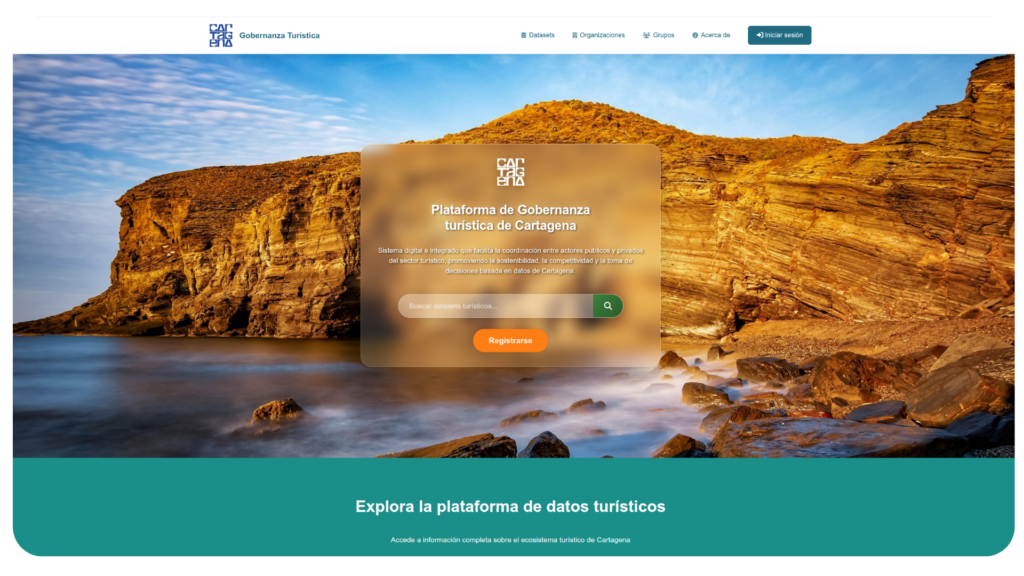
Cartagena has managed to break this cycle of uncertainty. The port city has not only complied with European regulations but has built an ecosystem where data flows from the sensor to strategic decision-making… and back. This is what we call the “virtuous circle”, a feedback loop that strengthens urban intelligence.
Summary
Cartagena turned the LEZ mandate into a data-driven “virtuous circle” that links precise IoT sensing, interoperable integration via iris360, and a domain-specific digital twin to simulate and optimize policies before implementation. This layered approach moves beyond dashboards to applied intelligence, reducing economic impact while maximizing health benefits and advancing “datacracy” and technological sovereignty. By scaling AI-enabled analytics and predictive models, Cartagena set a European benchmark for resilient, budget-efficient smart city management and funding capture. The whitepaper details the architecture and roadmap positioning this model as a 2026 standard.
From Sensor to Digital Twin: Layers of Value
Many Smart City projects fail because they stay on the surface (data capture through IoT sensors) and do not go further. They have a beautiful dashboard with a lot of data that they don’t know how to read or that remains isolated, without connection between data points.
At Libelium, we understand that the sensor is just the means. The end is applied intelligence: transforming the data that the sensor provides into smart, measurable decisions with a return on investment, whether at an economic level (with cost reduction, for example) or a social level (with the improvement of services and levels of well-being).
We present the case of the city of Cartagena. Its smart city project has evolved in collaboration with Libelium, which not only establishes it as a reference project for our entity but has also fostered a close relationship of almost complete trust in our solutions.
The case of Cartagena is paradigmatic because many cities have found themselves in the same situation, although not all have resolved it so well, making a virtue of necessity.
Like every city with more than 50,000 inhabitants, Cartagena must implement its Low Emission Zone to comply with global decarbonization objectives. Instead of making this obligation a barrier, the city decided to seize the opportunity to elevate its Smart City platform toward maturity.
- Precise Monitoring: Cartagena did not start from scratch; it already had a deployed network of Libelium IoT devices to accurately measure air quality and noise parameters.
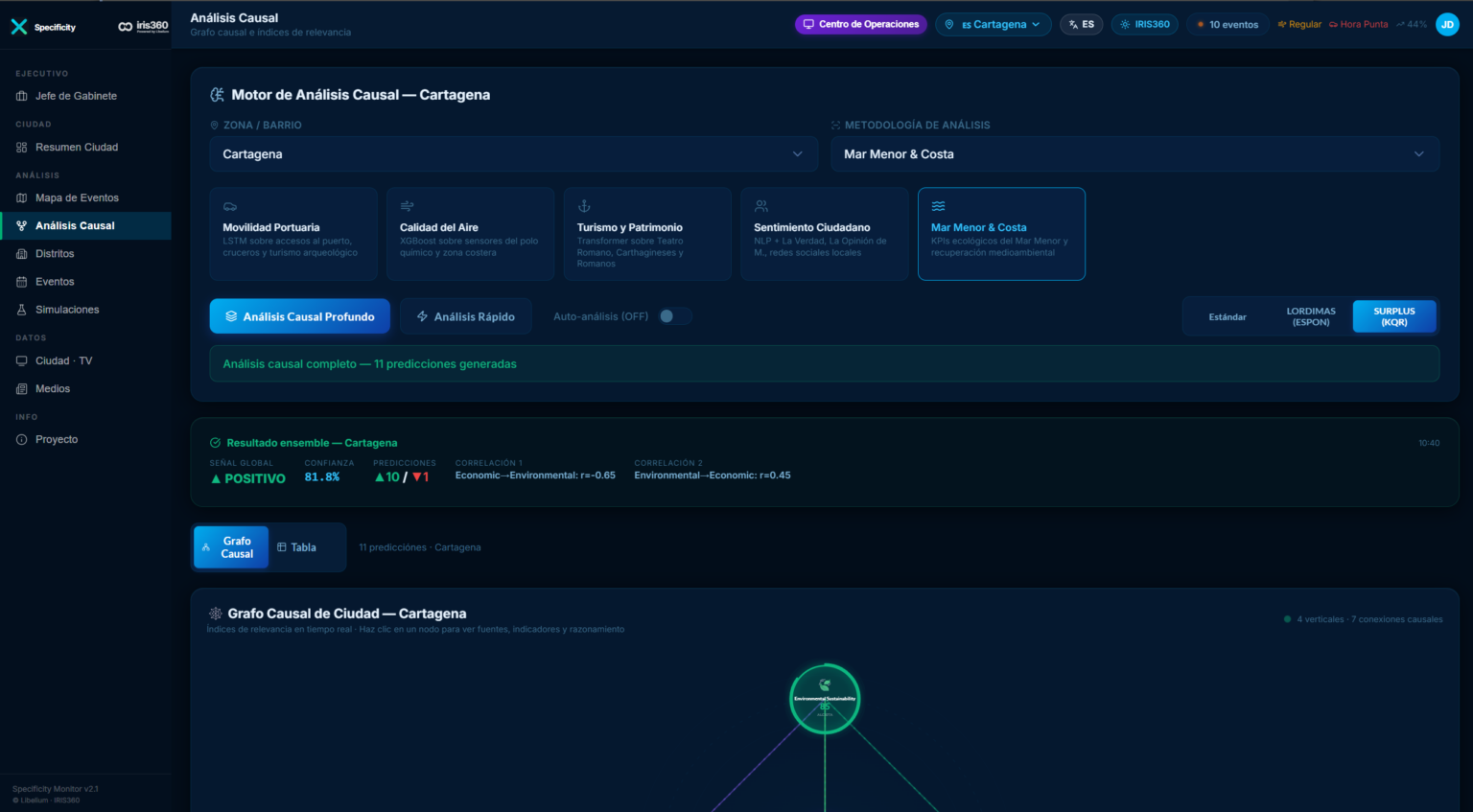
- Interoperability with iris360: The use of our platform breaks information silos, allowing environmental data to interact with each other. In iris360, other data can be imported (IoT devices from Libelium, from third parties, databases the city may have, data from data spaces, etc.) and algorithmic models are applied to extract value from those numbers that seem to float on the screen.
- Predictive Simulation: This is where the true return on investment lies. Through the creation of an air quality twin (a domain-specific digital twin), Cartagena has been able to simulate up to ten different traffic restriction scenarios before executing a single physical measure. These models not only incorporate data from the devices but also incorporate meteorological models (such as humidity or wind direction and speed) to refine the result.
This approach allows its managers to say:
“We do not restrict traffic based on intuition; we do it based on a simulation that guarantees the minimum economic impact and the maximum health benefit”.
From that data, this ‘super-block’ (supermanzana), is an example to follow nationally and Europeanly.

Datacracy: Data Sovereignty at the Service of the City
Of course, Cartagena did not stop there and has continued to improve the maturity of its platform by taking advantage of projects and subsidies, adding layers of intelligence to the smart city.
Once the value for one use case was extracted (the design of an LEZ), Cartagena has been exploring ways to implement artificial intelligence models, allowing technicians to exploit and interact with urban data to solve other use cases. This level of digital maturity has allowed Cartagena to lead European resilience projects and export its model to other cities on the continent, consolidating its technological sovereignty.
One of the most relevant milestones of the project in Cartagena is the evolution toward “datacracy“. It is not just about accumulating information, but about democratizing its access and utility.
Why This Model is the Standard for 2026
The era of experimentation with IoT is over. Cities and infrastructure companies need scalable, secure, and, above all, justifiable solutions. The Cartagena model demonstrates that when you have the support of a partner with 20 years of experience, technology ceases to be a cost and becomes the engine of budgetary efficiency.
We have documented every phase of this transformation in our latest Whitepaper. In it, we analyze how Libelium’s data architecture facilitated the capture of European funds and how the Digital Twin has become the definitive tool for crisis management and long-term urban planning.
The future of cities is not guessed; it is simulated, measured, and managed.
Download the full Whitepaper: The Virtuous Circle of Cartagena
Access the technical and strategic roadmap that has positioned Cartagena as a benchmark at the forefront of European Smart Cities. Discover how to apply these learnings to your data management and infrastructure projects.
Q&A
Behind the Change.
Beyond the Challenge.