


- The SURPLUS methodology allows for the calculation of the Return on Investment (ROI) of Smart Cities, quantifying both the fiscal surplus (budgetary savings) and the social surplus (monetized well-being).
- Local Digital Twin (LDT) technology and simulation scenarios are used for the preliminary validation of projects and to ensure municipal management based on objective data (datacracy).
- The generative and analytical AI integrated into SURPLUS functions as an impartial analyst, unifying data through standards such as NGSI-LD to generate actionable and auditable intelligence.
In the private sector, every employee is held accountable based on measurable objectives. A company strategy is defined, goals are established, KPIs are designed, and thus, the employee is focused on achieving them. Sometimes, they even receive a bonus for it. If results are not met, the strategy is changed.
Libelium processes this data to count vehicles every 30 minutes. By cross-referencing this information with other sources, such as public transport schedules and frequencies, the system ceases to be a snapshot of the present and becomes a predictive tool with temporal analysis capabilities.
However, in municipal management, we often accept that large investments are decided based on ideological impulses or electoral promises that are rarely audited after execution.
At Libelium, we have always advocated for datacracy: the conviction that decisions affecting public money must be based on objective data. If a professional is measured by their efficiency, why not a mayor or a councilor? Ideology should be reserved for the debate of values, philosophy, or personal development, but the management of common resources must respond to measurable parameters.
SURPLUS for Calculating Smart City ROI using Digital Twins (LDT)
To realize this vision, Libelium, in collaboration with Nunsys and the city councils of Barcelona and Valencia, has developed the SURPLUS methodology. This framework is designed for municipal administrations to calculate the return on every euro invested in technology, covering everything from sensors to decision-making. Essentially, the methods inherent to financial accounting are applied to the city’s digital twin.
Although public services are not for profit, they do have an obligation to be profitable in terms of impact. The SURPLUS methodology allows well-being, habitability, and sustainability to cease being abstract concepts and become auditable data. Thus, the citizen no longer just ‘assumes’ that their taxes serve a purpose, but verifies a direct return in the quality of their daily life.
What exactly is SURPLUS?
SURPLUS is the methodology that Libelium applies to its solutions to convert city problems into results that can be audited. This solution uses AI and the tools from the Local Digital Twins (LDT Toolbox of the European Union) to answer key questions, ensuring that every investment generates a fiscal and/or social return.
Instead of installing technology for the sake of installing it, we ask: What is the real value of this action before spending a single euro?
Libelium’s technology and the SURPLUS methodology act as an “impartial analyst”. By creating a digital replica of the city, municipal technicians can simulate the impact of a measure before spending the budget.
This achieves:
- Prior Validation: If the data demonstrates that a reform will not generate a real benefit, the investment is halted before the expense is incurred.
- Post-Investment Transparency: Once the project is executed, “Measurement Letters” are issued, which function as a success or failure audit, linking the technology directly to the city’s general ledger.
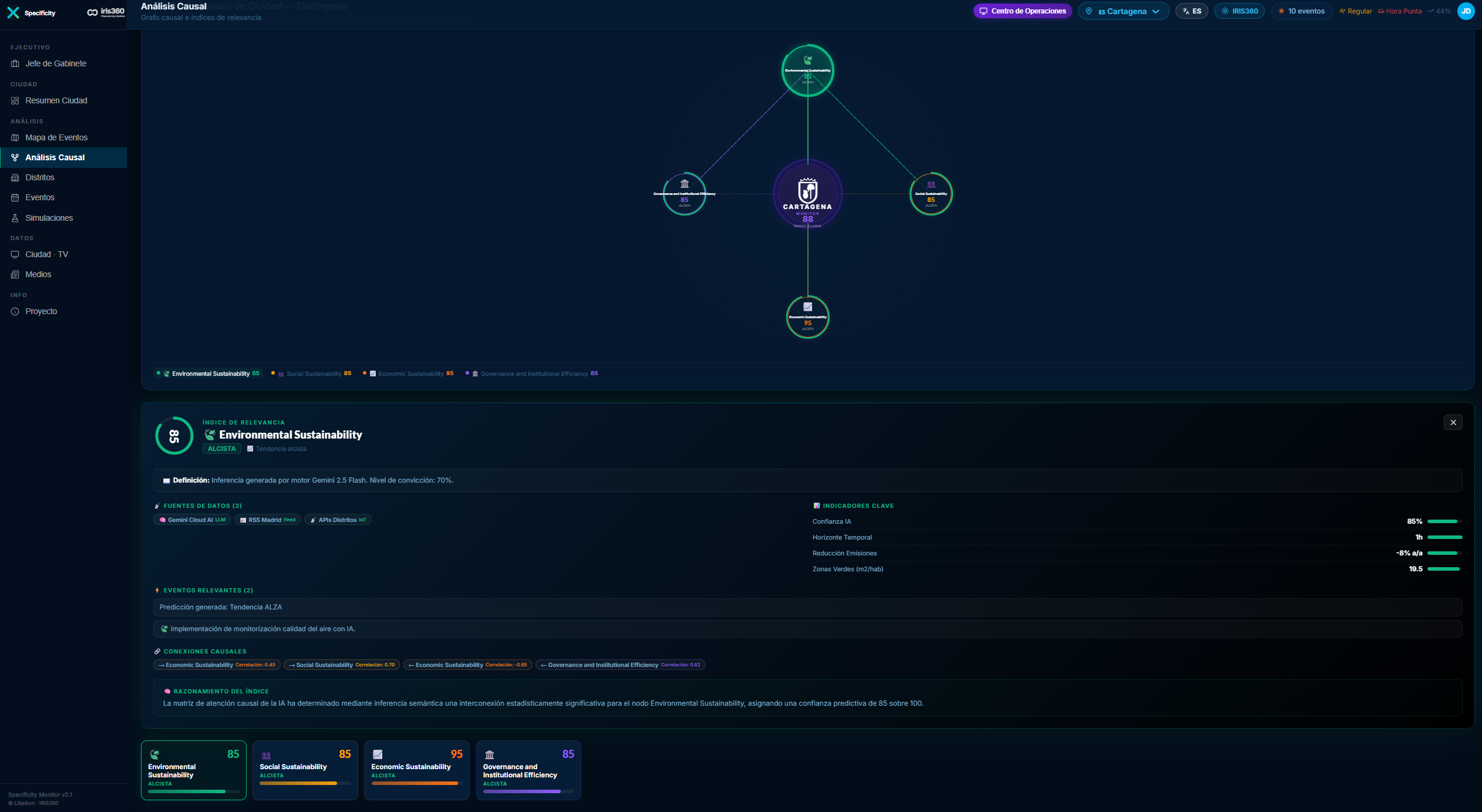
The Two Piggy Banks: What We Save and What We Gain
Normally, an administrator or manager only checks if the budget balances. SURPLUS proposes looking at two different “piggy banks” to determine if a project is worthwhile:
- The Money Piggy Bank (Fiscal Book): Direct savings in municipal accounts. If a city invests in smart lighting or water management, SURPLUS calculates exactly how much the electricity bill is reduced or how many leaks have been avoided, allowing for investment recovery in record time.
- The Well-being Piggy Bank (Social Book): The value of citizen well-being converted into data. Thanks to the use of Digital Twins, it is possible to measure how much money the city saves by improving public health (fewer hospital admissions due to pollution or heat) or by reducing the time residents lose in traffic jams, before applying any measure.
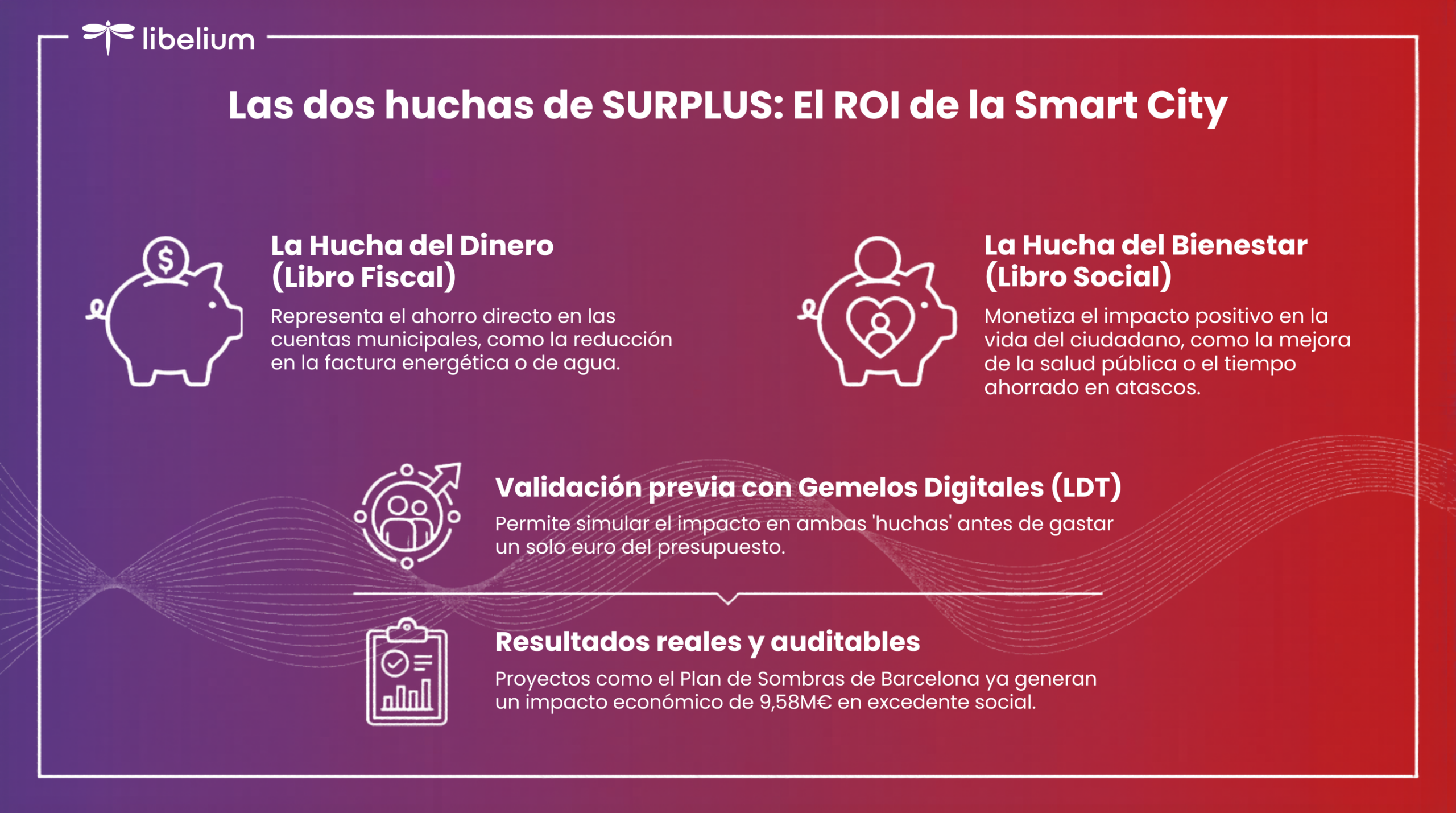
The 7 SURPLUS Steps
The name SURPLUS comes from these seven steps that the tool executes for its analysis:
- S (Specify): Define Key Business Questions (KBQ) with explicit value equations.
- U (Unify): Harmonize data using standards like NGSI-LD and Minimum Interoperability Mechanisms (MIMs).
- R (Run): Perform causal and counterfactual simulations in the digital twin to predict impacts.
- P (Prioritize): Classify initiatives by financial metrics such as NPV (Net Present Value) and IRR (Internal Rate of Return).
- L (Land): Translate models into Standard Operating Procedures (SOPs) and budgetary adjustments.
- U (Utmost): Implement KPIs and verify performance through a “Measurement Letter”.
- S (Scale): Convert the twin’s assets into reusable products for other districts or cities.
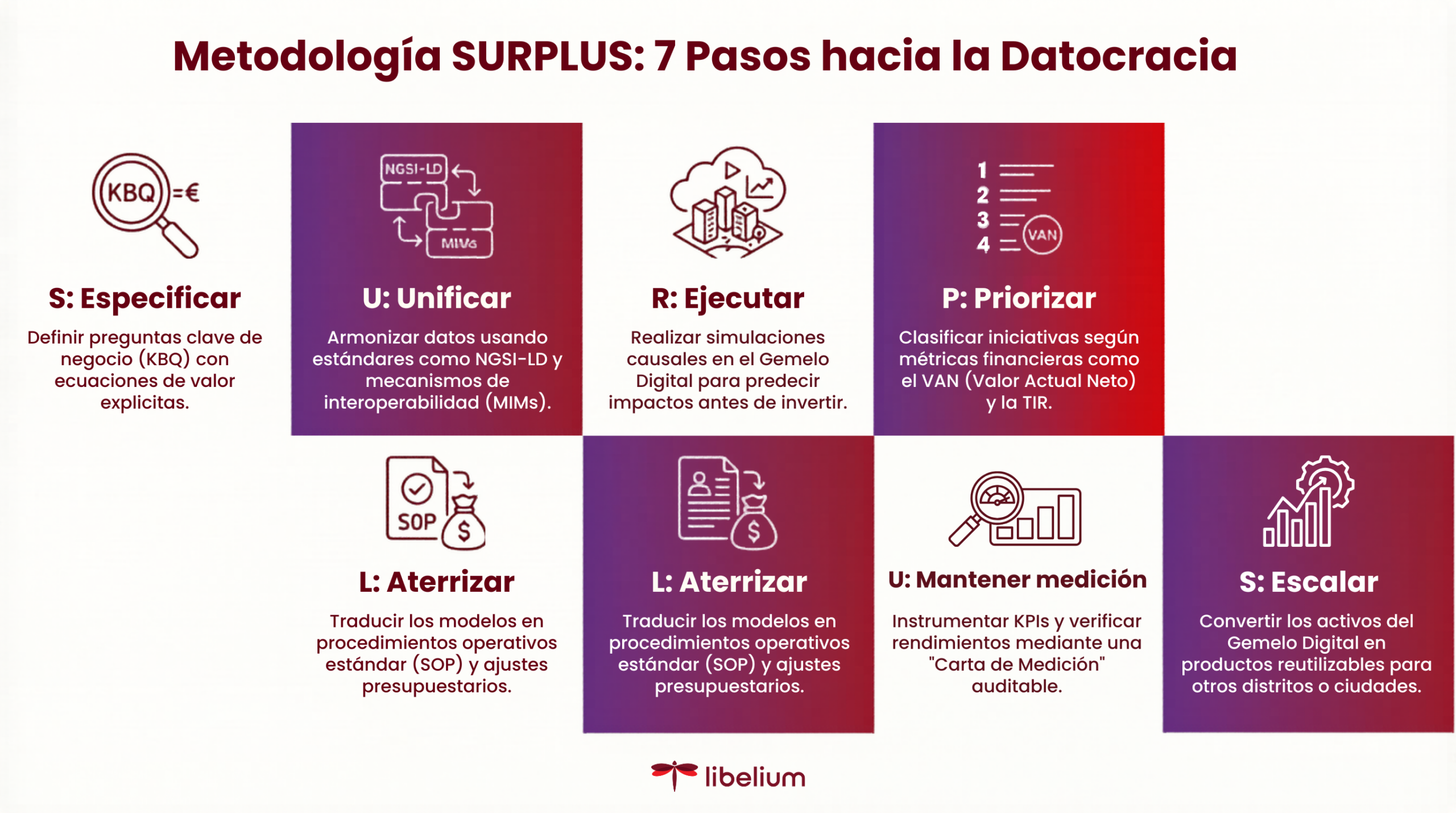
Building the Smart EconomyThe latest calls, such as the Red.es 2025 Smart Economy call, demand a leap from the traditional smart city to the smart economy. Technology will no longer be funded “just because,” but rather Smart Economy projects that demonstrate a direct impact on the local productive fabric, employment, and entrepreneurship. And this can only be achieved in one way: by measuring the return on every action. SURPLUS is the perfect ally to make this cut, as it transforms data into “actionable intelligence” and allows governance through the real value of data (the so-called datocracy). |
From Siloed Data to an Urban "Brain"
To make evidence-based decisions, Local Digital Twins (LDT) require a unified data architecture. The risk of turning data and its subsequent solutions (such as generative AI) into a new Tower of Babel means taking steps to break down those silos and translate information in a unified way so that any data-driven solution “speaks” the same language.
SURPLUS achieves this using the LDT Toolbox, a set of European Commission tools designed by Libelium and Nunsys, to create local digital twins, simulating and analyzing urban environments to improve planning. Based on interoperability, openness, and scalability, it enables local administrations to use digital twins for data-driven decision-making, policy testing, and sustainable development strategies.
What are these tools?
- Current Urban Maturity Models with LORDIMAS: The model starts from current models and maps, extends, and integrates systems like LORDIMAS. The LORDIMAS tool is a digital maturity assessment system for smart cities designed specifically for local, metropolitan, and regional governments. It was developed by ESPON in collaboration with the European Committee of the Regions and the partners of the Living-in.EU movement. While LORDIMAS evaluates the city’s prerequisites and capacity, the SURPLUS methodology uses these results as a “multiplier” or filter to select the investments that the city is truly capable of managing and making profitable.
- Semantic Interoperability with NGSI-LD: This technology allows a “light pole” or an “intersection” to mean the same thing to the mobility department as it does to the energy department. By using the ETSI NGSI-LD standard, data is organized into graphs that describe not only the object but its relationships with the environment.
- Minimum Interoperability Mechanisms (MIMs): These are the “minimum agreements” that ensure systems from different providers can talk to each other. This prevents the city from getting locked in with a single vendor.
- Generative and Analytical AI: In SURPLUS, AI acts as an analyst that gathers evidence from widely differing sources, checks units, and generates confidence memos so that municipal audits can give the green light.
- “What if…” Scenarios: Thanks to the Digital Twin, the city can run “what if…” simulations. For example, the impact of changing traffic light phases across an entire corridor can be simulated before touching a single wire on the street.
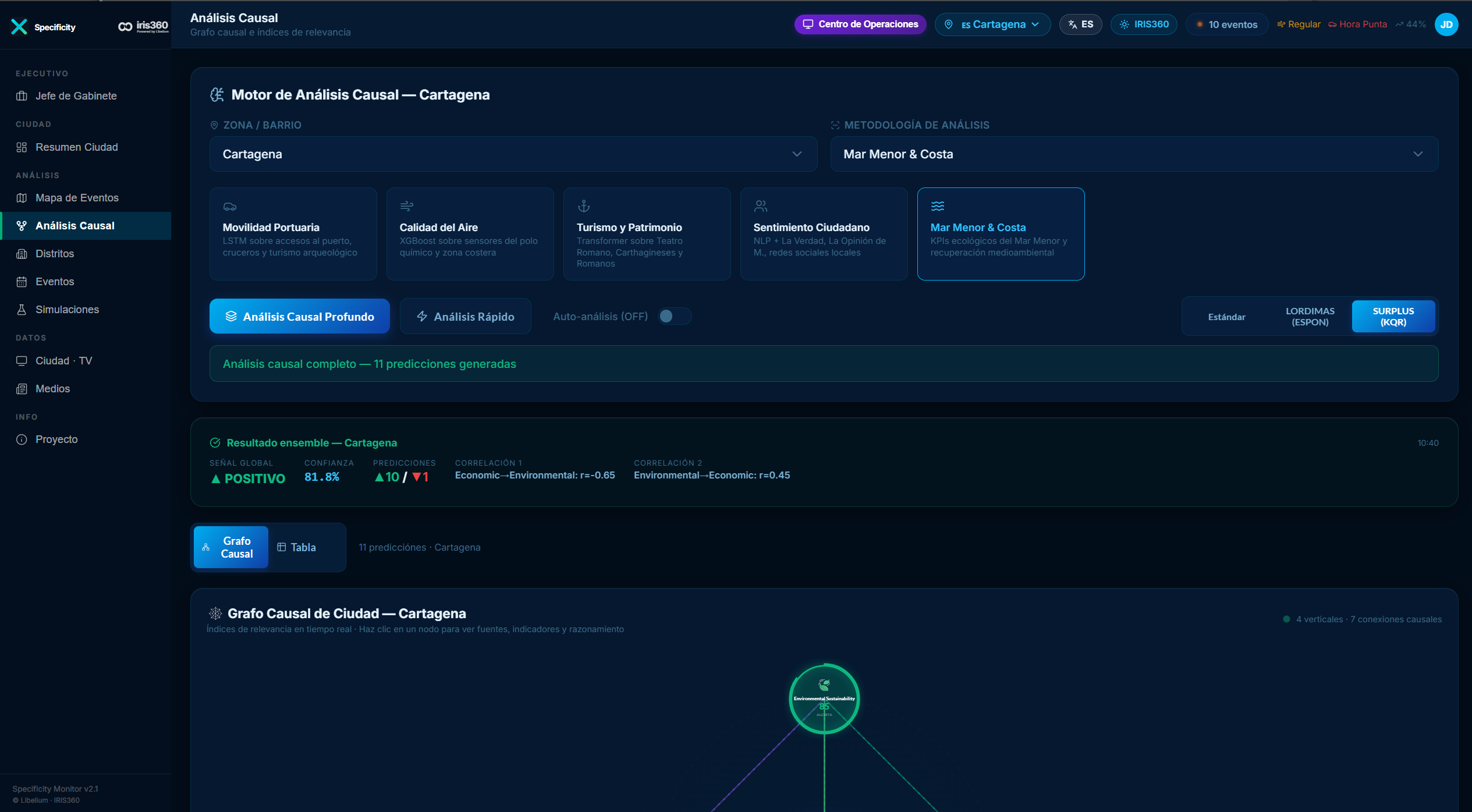
Results: Where is the Real Benefit?
The success of SURPLUS is measured in the fiscal and social surplus, the sum of budgetary savings and monetized social well-being.It has been designed and validated in various urban use cases to transform business problems into sustainable and quantifiable results.
No feature matches that search.
| Intervention |
City
|
Economic Impact (NPV over 10 years)
|
Social Surplus Detail
|
|---|---|---|---|
| Shade Program | Barcelona | €9.58 Million | Monetized public health: Fewer hospital admissions and mortality avoided due to extreme heat. |
| District Energy | Valencia | €1.45 Million | Optimization of cooling controls at the City of Arts and Sciences (rapid savings with low investment). |
| Low Emission Zones | Cartagena | €0.88 Million | Use of air quality sensors to improve cardiovascular health. |
| LED Lighting | Los Angeles | USD 11.3 Million | 64% reduction in energy consumption, saving USD 10M annually. |
| Adaptive Signals | Bellevue | €12.8 Million | The SCATS system returned valuable time to citizens (13% to 43% reduction in travel time). |
The intelligent management of a city involves solving urban challenges with profitable and sustainable measures. When data becomes the basis for decisions, the administration becomes fairer and more efficient.
Ideology is fundamental for deciding what kind of society we want to be at our core, but when deciding how to manage traffic or reduce energy consumption, the best tool is, and always will be, objective data.
Where to Start?
The first step to applying SURPLUS is to evaluate a city’s digital maturity to define a roadmap that allows city councils to identify their technological weaknesses. To do this, SURPLUS connects with LORDIMAS, the European Commission’s digital maturity assessment tool, to evaluate the administration’s current standing.
If, for example, a city has a low score in data management in LORDIMAS, SURPLUS will recommend a smaller, more realistic project to prevent waste.
Ultimately, SURPLUS converts the city’s digital twin into a decision and audit platform, allowing city councils to manage their resources as efficiently as possible and with the best return on investment.
Behind the Change.
Beyond the Challenge.