
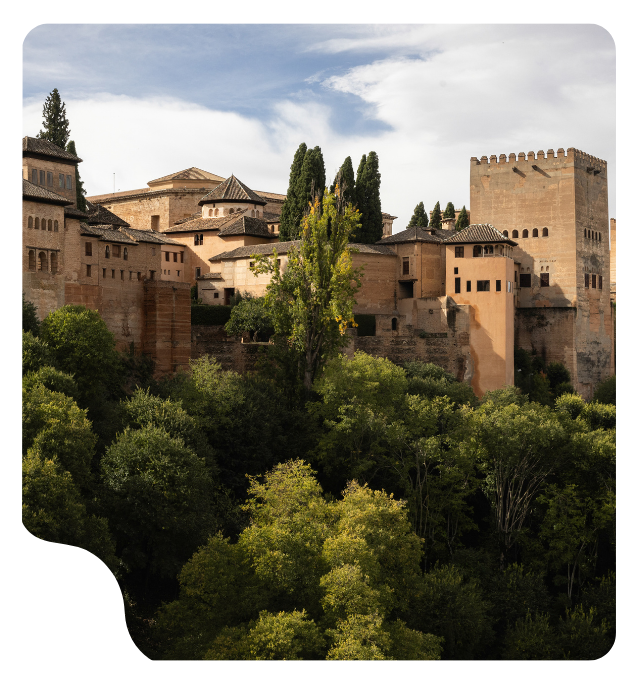
The Alhambra, Spain’s heritage jewel and Granada’s tourist emblem, enters a new era thanks to the Alhambra Living Lab project, driven by the Andalusian Digital Agency (ADA) within the framework of PRTR (Next Generation EU) funds and coordinated by Sandetel.
Under the technological leadership of Libelium, this ambitious plan has a clear purpose: to conserve, manage, and make this historic environment more accessible through IoT sensors, artificial intelligence, and digital twins.
A pioneering example of how technology can protect the past without relinquishing the future.
What is a Digital Twin and how does it help preserve the Alhambra?
A digital twin is a virtual replica of the physical environment, capable of receiving real-time data, analyzing its behavior, and even anticipating potential deterioration or emergencies. Applied to the Alhambra, this represents a paradigm shift in heritage conservation: it is monitored without touching, managed without intervening, and protected without altering.
The system combines environmental and structural sensors with predictive algorithms, generative AI, and open data platforms such as FIWARE.
The entire ecosystem is coordinated alongside the Board of the Alhambra and Generalife, the Andalusian Digital Agency, Sandetel, and Libelium, forming a true living laboratory of innovation.
How the technology platform developed by Libelium works
Thanks to this open architecture, the project allows to:
- Monitor critical variables in real time, such as temperature, humidity, or vibration.
- Forecast structural damage through AI-driven pattern detection.
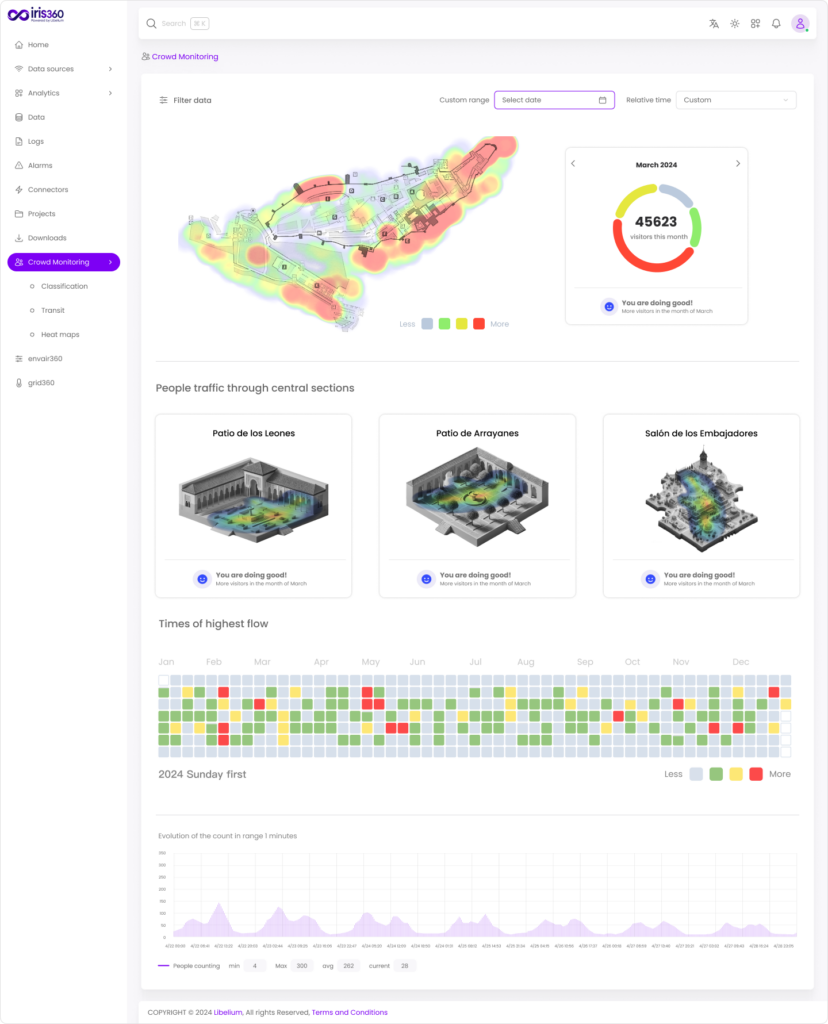
- Manage tourist footfall and redistribute flows to prevent overcrowding.
- Reduce energy and water consumption through automated adjustments.
- Provide cultural information to visitors via augmented reality.
All of this will be carried out without physical impact on the monument, keeping its essence intact. The technology will act as an invisible second skin based on iris360.
9 real-life use cases to develop the Alhambra Living Lab Digital Twin
This digital twin is not a mere theory. It has been deployed across 9 practical applications that are already transforming the management and preservation of the site:
1. Intelligent tourist flow control
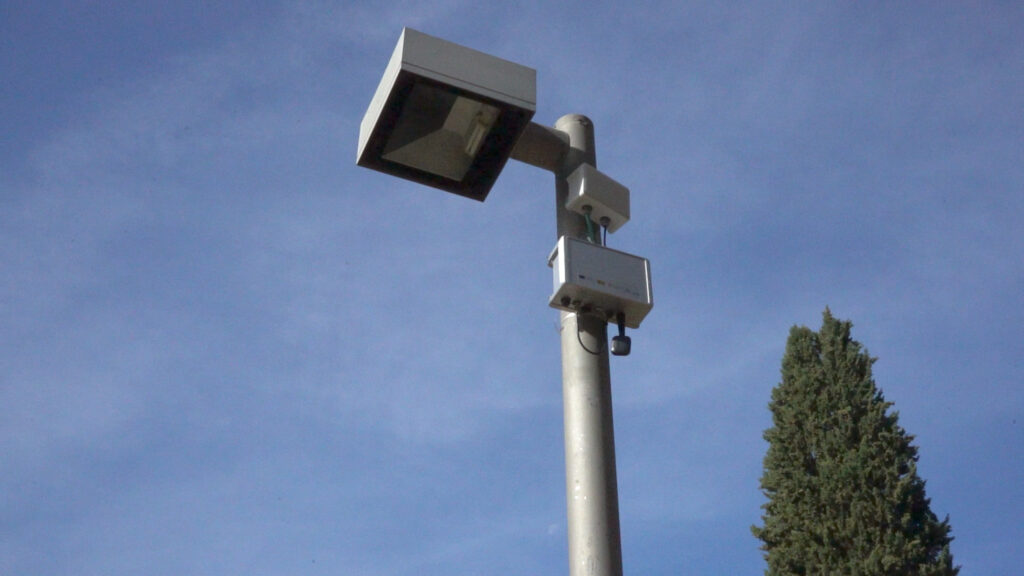
With over 30 counting sensors and cameras, the system detects overcrowding, optimizes access points, and predicts peak moments. Thus, heritage is protected while visitor experience is improved.
2. Environmental sensors for non-invasive conservation
Libelium One devices monitor structural and environmental conditions. Algorithms like LSTM, ARIMA, or FEM anticipate risks without needing physical intervention.
3. Augmented reality and gamification
Thanks to BLE beacons, GPS, and QR codes, an immersive and educational tour is offered, complete with historical reconstructions, cultural challenges, and content tailored by age and language.
4. Digital biodiversity inventory
In green areas, sensors monitor local flora and fauna. A map of living species is generated, useful for ecological decisions and environmental management.
5. Energy and resource optimization
Real-time measurement of water, electricity, and HVAC consumption enables fine-tuning of resource usage, reducing costs and environmental impact.
6. Multilingual interactive assistants
Powered by generative AI, information points detect visitor languages and adapt content to their needs, enhancing cultural accessibility.
7. Evacuation simulations
Dynamic analysis of evacuation routes based on sensor-detected movement, valuable for drills, emergency planning, and civil protection.
8. 360º virtual tour and immersive metaverse experience
Navigable 3D recreation of the Alhambra accessible from any device. Ideal for individuals with reduced mobility, educational purposes, or remote visits.
9. Climate impact prediction
Over ten weather stations and Smart Spot Air & Noise sensors predict the impact of tourism and weather on the monument’s surrounding environment.
Lorem ipsum dolor sit amet, consectetur adipiscing elit, sed do eiusmod tempor incididunt ut labore et dolore magna aliqua. Ut enim ad minim veniam, quis nostrud exercitation ullamco laboris nisi ut aliquip ex ea commodo consequat. Duis aute irure dolor in reprehenderit in voluptate velit esse cillum dolore eu fugiat nulla pariatur. Excepteur sint occaecat cupidatat non proident, sunt in culpa qui officia deserunt mollit anim id est laborum.
Open technology for global heritage
One of the pillars of Alhambra Living Lab is its open and interoperable approach. It is not just about preserving a historical site, but about laying the foundation so that other cultural, urban, rural, or natural spaces can follow its lead.
Furthermore, this platform provides immense value to academia, public managers, and smart tourism professionals.
The future of conservation is smart
The Alhambra Living Lab project demonstrates that heritage preservation is compatible with innovation. Thanks to respectful digitalization, artificial intelligence, and connected sensors, the Alhambra is not only protected, but brought to life for millions of people.
At Libelium, we firmly believe in technology that serves, protects, and connects. And this project confirms that: caring for the past is also embracing the future.
Technology to preserve beauty.
Innovation at the pace of legacy.
The initiative, developed within the framework of the Alhambra Living Lab project, was driven by the Andalusian Digital Agency in collaboration with the Alhambra and Generalife Board of Trustees, the University of Granada, and the technology company Libelium. It involved an investment of over €2.3 million, 75% of which was co-financed by the European Union’s NextGeneration funds as part of the Spain Living Lab project, which is integrated into the Retech program.

Behind the Change.
Beyond the Challenge.