Barcelona will be able to predict traffic jams and simulate traffic disruptions using digital twins and telephone data

Table of Contents

digital twin of traffic in Barcelona

The Barcelona metropolitan area is one of the most complex logistics environments in Europe. Managing the flows of goods entering and leaving the city requires tools that go beyond direct observation. This premise gave rise to the M4M project, an initiative that uses advanced mobility services on a data space coordinated by i2CAT. The deployment, pioneering in its scope, is not limited to the capital, but integrates data from the urban center of Barcelona together with the municipalities of Sant Boi de Llobregat and Terrassa.

The origin of the information from the antenna to the map

This system is not based solely on cameras or sensors installed on the road surface. The project uses anonymized information from MasOrange, which comes from cell phone towers located at strategic points. These signals are picked up on the main access highways and critical thoroughfares such as Avenida Diagonal, La Meridiana, Calle Aragón, and Gran Vía.

Libelium processes this data to count vehicles every 30 minutes. By cross-referencing this information with other sources, such as public transport schedules and frequencies, the system ceases to be a snapshot of the present and becomes a predictive tool with temporal analysis capabilities.

Logo M4M project

The technical perspective: “What-if” analysis

“The M4M project promotes a new way of managing mobility in the Barcelona metropolitan area, integrating aggregated and anonymized data from the mobile network with other urban sources in an interoperable data space. Thanks to advanced analytics, prediction, and “what-if” scenario simulation, M4M converts information into operational metrics and practical tools, such as dashboards and query services, which help anticipate congestion, optimize transportation, and assess the impact of infrastructure measures and restrictions”


This capability allows us not only to observe, but also to anticipate mobility issues and act proactively.

A digital twin for sustainability

By using a digital twin, municipal managers can run scenario simulations to assess the impact of a measure before physically implementing it.

This predictive capability helps detect congestion peaks days in advance, making it easier to adjust public transport frequencies before gridlock occurs. Likewise, in the event of possible road closures or changes to the Low Emission Zone, the city council can simulate how traffic will be redistributed and calculate the extra time required for journeys. In addition, the model translates traffic intensity into pollutant emission estimates, linking mobility decisions to air quality.

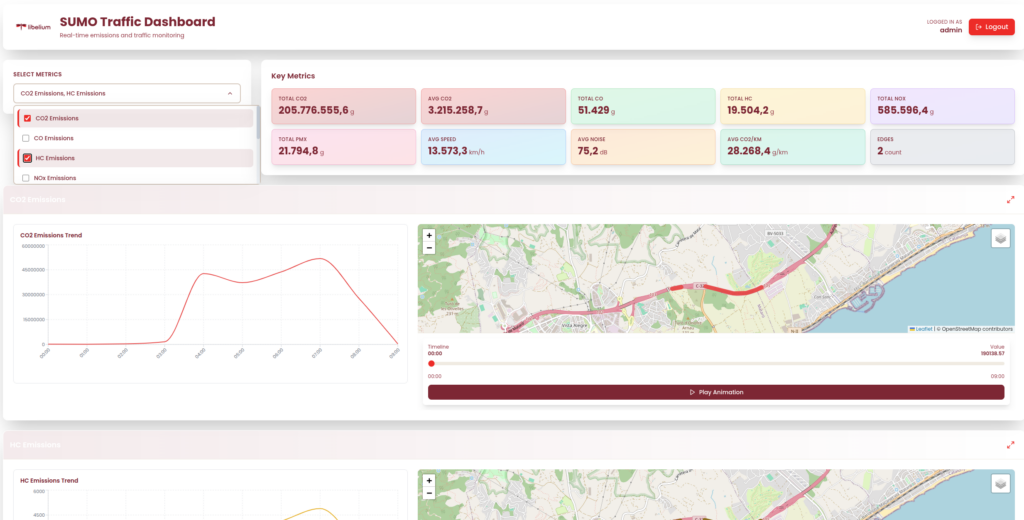
Dashboard M4M

"The initial Dashboard prototype provides an intuitive visualization of nine real-time traffic and emissions metrics (CO2, pollutants, speed, noise) (all with test data, not exactly real). What is innovative is the ability to simulate “what-if” scenarios using a digital twin, allowing urban managers to evaluate policies before implementing them. The time evolution component shows how pollution changes throughout the day in both graphical and tabular formats, allowing multiple variables to be selected for visualization."

Security and sovereignty in data use

A fundamental aspect for administration is the governance model. Information is exchanged under a federated framework that ensures data is used only for agreed purposes. This maintains traceability and compliance with regulations such as the European Data Act, so that the customer retains control over who accesses the information and under what conditions.

The value of telephone data compared to traditional sensors lies in its coverage. While a physical sensor only detects what happens at a specific point, the mobile signal allows us to understand the origin and destination of flows, offering a complete view of how the population actually moves throughout the municipality.

Consortium structure and funding

The M4M project is being developed by a consortium led by Libelium and Orange Espagne SAU, with both entities sharing 50% of the responsibility. 

"Thanks to the aggregated and anonymized data from a network as extensive as Orange's, the M4M project is able to obtain an accurate and up-to-date view of the volume and patterns of mobility on the main roads and strategic points in the Barcelona Metropolitan Area. This analysis effectively complements traditional sources and allows for better planning, resource optimization, and the design of more effective public policies. This project is a clear example of how public-private collaboration accelerates urban transformation and contributes to building more efficient, sustainable, and future-ready cities."

The proposal has received funding from the European Union-NextGenerationEU, with the support of the Government of Catalonia (Departament of Business and Labor). 

The project is currently in the development phase, following a six-stage schedule. A first functional prototype is expected to be ready by the end of February, while the final version and full impact assessment will be presented at the end of March. The Catalan government is supervising the progress of these models to ensure that mobility management in Barcelona is based on solid evidence.

Generalitar
Logos Next Generation UE GobEsp PRTR

Behind the Change.

Beyond the Challenge.