


Scaling smart city projects presents the challenge of managing data ingestion and cloud storage costs. Furthermore, there is the need to base public policies on verified information that is secure against cyberattacks. While large cities can dedicate resources to these areas, scalability can create economic bottlenecks that compromise the sustainability of any digitalization project.
A gigabyte of data that requires an active database costs around $0.21/month. Projects dedicated to the dual transition, green and digital, require gigabytes and gigabytes of data, so the problem is evident. For medium-sized cities, this economic barrier hinders technological progress.
To resolve this economic bottleneck, iris360 incorporates the ELT Medallion model into its data architecture to optimize processes while reducing costs associated with data storage up to $0.023/month.

Understanding the ELT Medallion architecture in iris360
The ELT Medallion architecture evolves the traditional ETL (Extract, Transform, Load) approach into a model structured in three progressive layers: bronze, silver, and gold.
This methodology distills the flow of information from heterogeneous sources (water or electricity consumption, CSVs, mobile data, weather, IoT sensors) to break down silos and build reliable datasets.
This is how it is structured in Libelium’s data governance and intelligence platform, iris360:
- Bronze Layer (Cleansing): Extracts data from the datalake and executes the initial cleaning process. It not only eliminates erroneous or unusable data but also converts them into objects, reducing the cost of massive storage to about $0.023/GB/month. This does not mean the data disappears, as it maintains an unalterable historical record through an append-only model suitable for audits.
- Silver Layer (Normalization and Quality): Processes the clean data from the Bronze layer to apply technical and semantic normalization under the NGSI-LD standard. In this phase, strict typing rules, deduplication, and structuring into tables are applied, consolidating the “single source of truth” for analysts and interconnected systems.
- Gold Layer (Aggregation and Business Intelligence): Applies advanced transformations through metric aggregation, feature extraction, and execution of training models. It injects into the iris360 query engine only the information ready to feed dashboards, predictive algorithms, and digital twins.
A destillation process to get the golden data, a.k.a. ground truth.

Layer | Data Status | Key Operations | Main Use |
Bronze (Raw) | Raw / Direct ingestion | Append-only insertion, preservation of original schemas, unmodified history. | Audit, backup, and reprocessing. |
Silver (Cleansed) | Clean and Validated | Cleansing, deduplication, strict typing, normalization, and table joining. |
|
Gold (Curated) | Aggregated / Business | Dimensional modeling (Star Schema), KPI calculation, business aggregations. | BI Dashboards, executive analytics, and ML models. |
Benefits are not only economic in terms of maintenance cost savings, but reach broader aspects: from cybersecurity and traceability to improving the continuous efficiency of data processing:
- It allows dumping millions of events per second (sensors, logs, clicks) into Bronze at high speed without immediate processing, decoupling ingestion from transformation.
- It allows separating ingestion failures (in the Bronze layer) from errors in business logic rules (in Silver and Gold) without breaking anything.
- By preserving raw data in Bronze, it is possible to rebuild or recompute all subsequent layers if analytical rules change, without querying origin systems again.
- It uses modern storage formats to ensure consistency and simultaneous read/write without corrupting the data.
- It replaces complex traditional ETL pipelines with continuous flows (streaming or batch) where the structure is perfected step by step.
- It ensures that any department accesses normalized, clean information ready for immediate use, eliminating technical access barriers.
- It replaces blind estimates with analysis based on verified evidence, raising reliability in critical public decision-making.
- It breaks organizational divisions by integrating coherent workflows, allowing technical teams and managers to share a single, truthful vision of the city.
High ENS Cybersecurity and the path toward datocracy
Structuring information in layers reduces costs and lays the foundation for regulatory compliance. The iris360 architecture has certification in the High Category of the National Security Scheme (ENS) in its 5 dimensions:
- Authenticity and Integrity: They certify the certainty of the data origin and ensure that influx or consumption metrics are immune to external manipulation.
- Confidentiality and Availability: They encrypt sensitive city information and ensure 24/7 platform operativity.
- Traceability: They provide an immutable and auditable history of each registered event.
Filtering in the Gold layer and the High ENS shielding allow urban managers to practice “datocracy.” Administrations replace blind estimates with economic evidence to dimension health center capacity, adjust police shifts, or plan waste collection based on real population density.
The Benidorm case study
To understand the true complexity behind a data platform for smart cities, it is useful to observe a real and equally complex deployment.
We mentioned earlier that medium-sized cities can have problems with data ingestion, to the point of slowing down digitalization projects that help improve the livability of these cities and their public services.
That is why, when we had the opportunity to work with the Benidorm City Council to implement a solution that would help them calculate how many people live fixed-term and temporarily in their municipality to improve their public services, we knew that implementing the Medallion ETL would be crucial.
The Benidorm City Council has launched a digital twin to know with greater precision the city’s floating population and optimize the management of public services. To do this, it will use iris360, Libelium’s data intelligence platform.
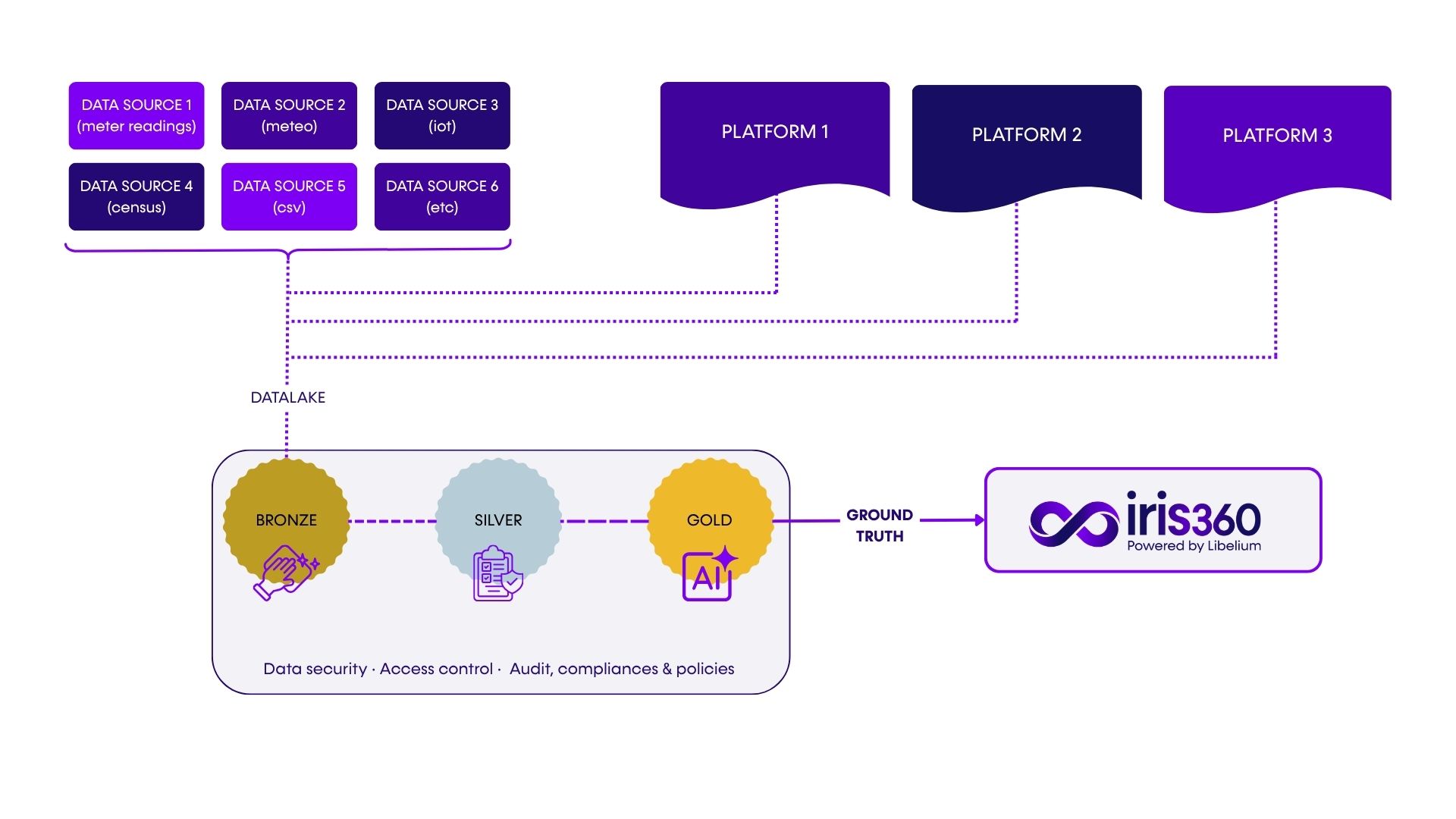
This project involves managing multiple data sources from different providers, including energy and water consumption, mobile network indicators, census data, and meteorological data, among other sources of information.
Integrating all this information into a single platform can easily become not only a technical nightmare (different formats, update frequencies, governance restrictions, and quality levels) but also a prohibitive cost for the municipal budget if each integration is treated as an isolated project.
That is why we have implemented a Medallion ETL approach in Benidorm: ingest from the datalake and quickly clean all information in the Bronze layer, apply standardization and validation in the Silver layer, and publish selected and ready-to-use datasets in the Gold layer. This ground truth is the data that the iris360 AI will take to train and correct discrepancies between the registered population and the real density of people in the locality.

The result is a predictable integration pattern that reduces costs, accelerates delivery, and maintains the ability to evolve as new providers and datasets are added.
Furthermore, the iris360 platform is interoperable with the SEGITTUR central node, so it can connect directly to the Alicante PID and the Benidorm SmartRegion platform to integrate a wider spectrum of urban data sources, such as beach influx or vehicle traffic through computer vision systems, connecting all city layers.
Adopting this model gives cities tools to scale their analytical capacity and build a more efficient connected future.
The role of Medallion architecture in Smart City solutions
Smart cities make decisions based on data. If their decisions are to be based on data, these must be as accurate as possible, but also secure and efficient. The Medallion architecture plays a fundamental role in generating this information by integrating diverse data sources from various data providers, both external and internal, to the digital brain that is the smart city platform.
The key to this approach lies in the ability to manage large volumes of data. With the Medallion architecture, cities can collect data from traffic systems, energy networks, water networks, environmental monitoring, and public services in a coherent model for analysis and decision-making without this impacting an increase in costs.
Data integration between various public and private actors, facilitated by the iris360 architecture, allows solving complex use cases by eliminating barriers between departments and external providers to offer fluid services to the citizen.
- Real-time emergency management: by connecting IoT sensors (external providers) with traffic control systems and emergency vehicle fleets (internal departments), the system prioritizes routes and traffic lights automatically, drastically reducing response times.
- Dynamic urban planning: by combining data from mobile networks (external companies) with public service records (municipal companies) and census data, the city sizes services like waste management or transport according to the real floating population, optimizing public resources.
- Active environmental sustainability: by integrating air quality measurements (external sensors), traffic data (mobility department), and weather forecasts, managers activate traffic restriction protocols only when strictly necessary, guaranteeing operational efficiency and citizen well-being.
Data flows as citizens do.
In addition, the flexibility of the Medallion data architecture allows offering personalized services. By understanding citizens’ needs, cities can adapt services to meet changing demands, without needing to redesign the entire data infrastructure every time a new provider or dataset appears.
Resilient and sustainable smart cities with collaboration
In the dual transition of cities (digital and green), Libelium acts as the necessary bridge for cities and providers to join forces, transforming data into real actions that improve public services.
Even within the management of the city itself, there may be data locked in silos between different departments that must be integrated into a single platform because citizens do not interact in isolation with the city, but do so fluidly. Thus, the city’s organization must function the same way. Here, the ETL Medallion architecture makes total sense for close and interconnected collaboration between different offices.
Success does not depend only on the tool, but on the close collaboration between whoever manages the city and whoever provides the data, breaking down barriers to work under the same vision.
iris360 allows this cooperation to be fluid and constant, ensuring that every byte of information translates into a measurable improvement in our common fight for a more sustainable future.
The future of data solutions for smart cities
Smart city solutions like those offered by Libelium are transforming urban environments with unprecedented efficiency. The Medallion architecture plays a fundamental role by organizing data into usable layers that strengthen decision-making and service provision.
Benidorm illustrates the practical challenge: coordinating multiple providers and domains is complex and costly if approached as a set of custom integrations. An ETL pattern based on Medallion creates a repeatable and scalable way to incorporate data into platforms like iris360 and provide reliable datasets for municipal services.
ooking to the future, attention must focus on sustainability, security, and adaptability. By leveraging the scalability and governance advantages of the Medallion architecture, cities are better prepared to meet changing needs and deliver measurable results for citizens.
Behind the Change.
Beyond the Challenge.