
Whitepaper: Advanced Dynamic Line Rating solution reduces prediction error by 62%
Table of Contents
Stop relying on inaccurate NWP models for your DLR
The global energy transition towards green sources demands an intelligent, dynamic, and flexible electrical grid. For TSOs (Transmission System Operators) and DSOs (Distribution System Operators), the challenge is not only integrating renewables grid volatility (solar and wind) but also managing its inherent volatility.
Inaccurate wind prediction for power lines, the most critical factor in the dynamic line rating (DLR), the capacity of high-voltage lines, becomes an operational risk and a barrier to grid optimization.
The Challenge: NWP model limitations and conservative margins
Historically, Numerical Weather Prediction (NWP) models have been the basis for forecasting wind and other environmental variables that influence energy transport in overhead power lines, but the inherent NWP model limitations, limited resolution and physical simplifications generate systematic errors that force operators to work with excessively conservative safety margins. This means that lines often operate far below their actual capacity.
grid360: An advanced Dynamic Line Rating solution
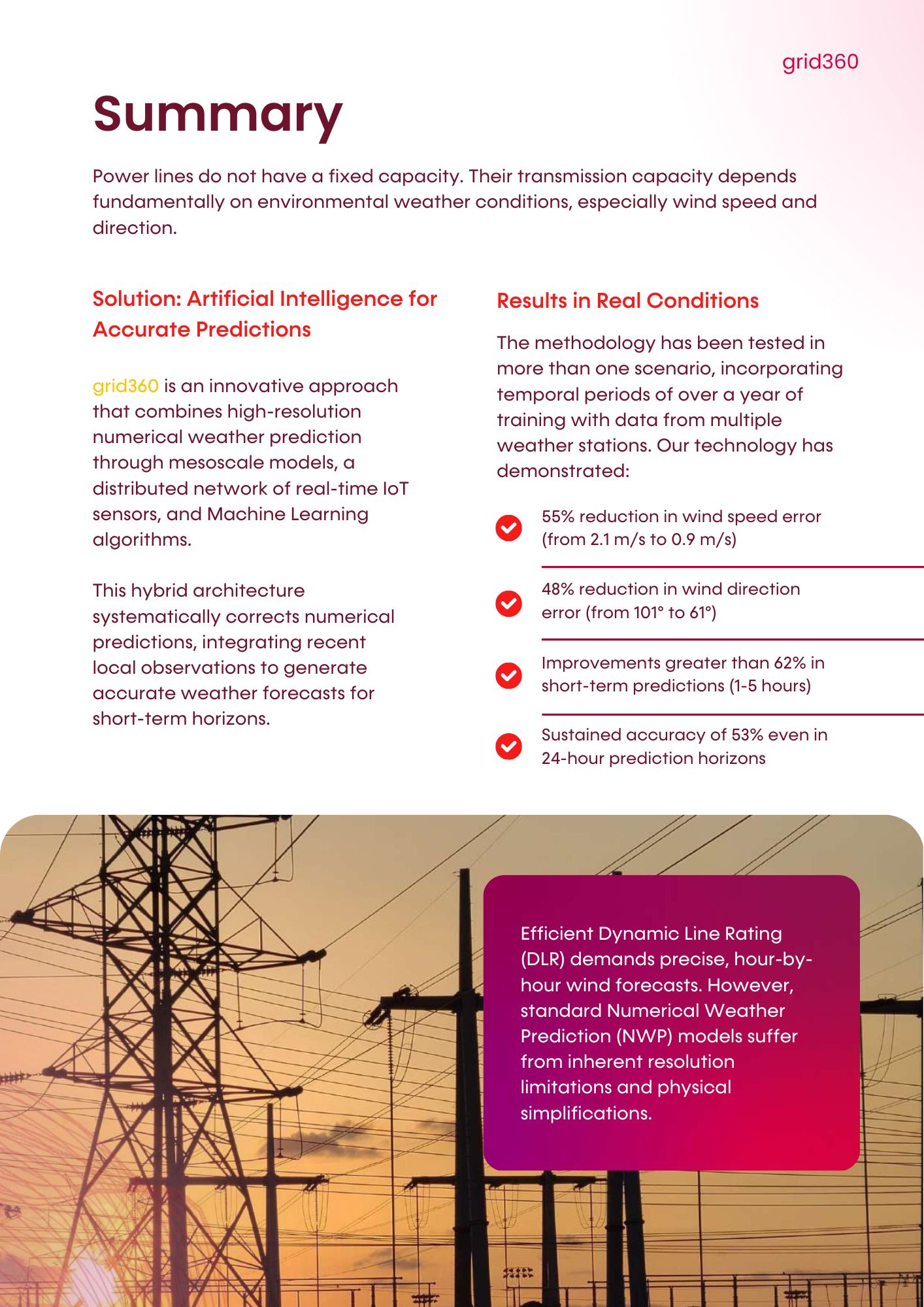
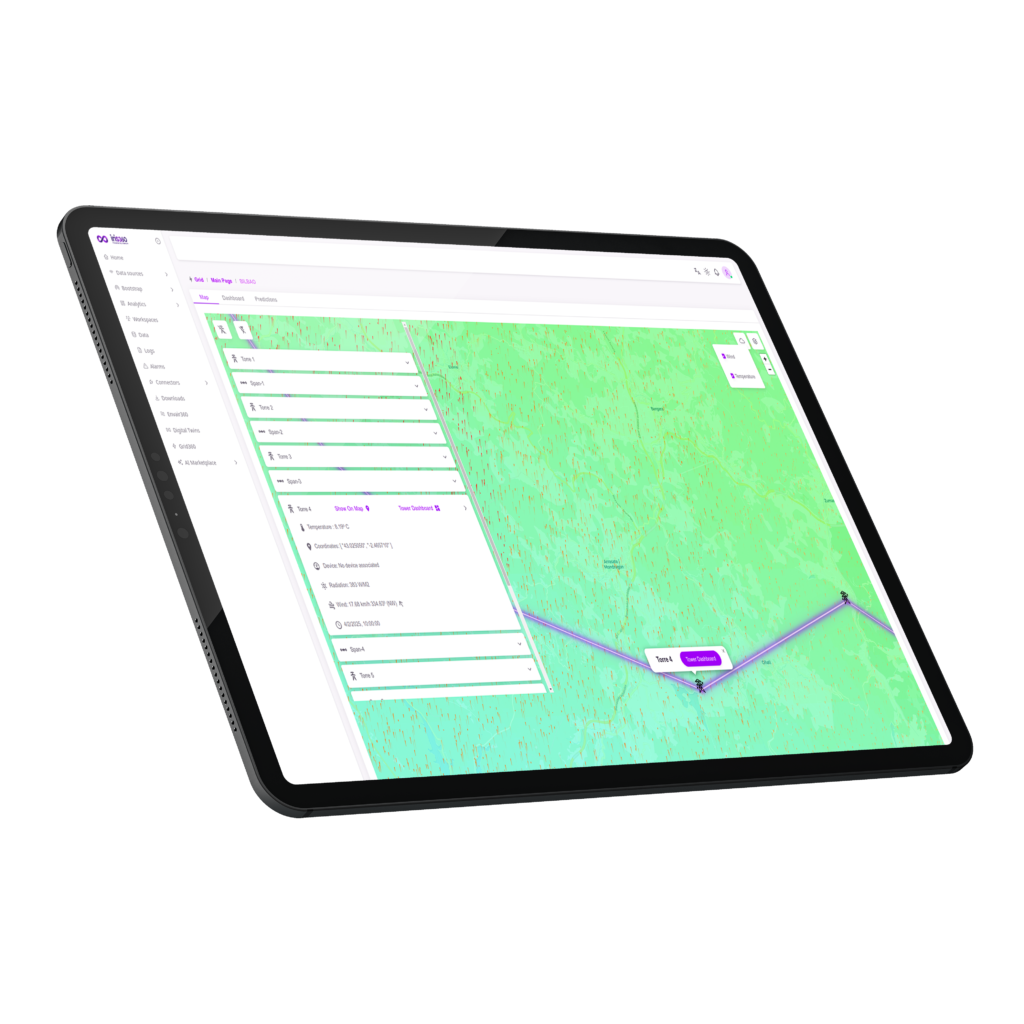
At Libelium, we have addressed this challenge with grid360, a Machine Learning architecture that serves as an advanced Dynamic Line Rating solution, overcoming the limitations of traditional models. Our solution combines the best of two worlds:
- The training of numerical prediction models with advanced machine learning.
- The real-time precision of a distributed network of IoT sensors installed on the power lines themselves.
This hybrid approach allows us to correct and improve the accuracy of NWP to generate highly reliable wind predictions with a significant improvement in meteorological prediction for the following 24 hours, potentially extending to 72 or 96, but with the result’s precision being especially significant in the first 5 hours, which experts call nowcasting for the electrical grid.
Why wind is critical for ampacity calculation?
Wind is a critical factor for ampacity calculation on a power line, which is the maximum current that a conductor can continuously carry without exceeding its operating temperature limit. The transmission capacity of a power line is not fixed but depends on weather conditions.
Power lines, those that link our landscapes almost unnoticed, heat up when carrying current. If the temperature exceeds a safe limit or if the conductor expands and sags too much (the power line sagging risk, which reduces the safety distance to the ground), safety is compromised.
Wind not only guarantees safety but also becomes a resource that allows for greater penetration of renewable energies and more efficient and flexible system operation. An increase in wind speed of only 1 to 5 m/s allows for an increase in sustainably generated wind production on the energy generation side, and an increase in transport capacity by up to 81% on the energy transmission side.
Demonstrated results: 62% error reduction and 30% ampacity increase
At street level, we might not notice much difference in wind speed one meter up or down, but in terms of energy transmission, speeds higher than 6 m/s imply a 50% increase in ampacity. These findings underscore the importance of obtaining extremely accurate meteorological data to determine the adapted line performance.
The results of the Libelium forecast for the grid360 solution are conclusive. We have demonstrated a significant reduction in prediction error, especially in the most critical horizons for active grid management, achieving improvements of up to 62% in error reduction (MAE) in short-term predictions (1 to 5 hours). This precision remains robust throughout the entire 24-hour horizon, transforming the capacity of TSOs to plan energy transport and maximize the efficiency of their assets.
Libelium had already managed to increase ampacity by 30% across 500 kilometers of lines in Spanish territory. Aware of operating in a sector where every meter, every minute, and every kilowatt counts, continuous improvement has allowed us to enhance the precision of our grid360 solution even further, delivering a clear advantage for TSOs and DSOs.
Access the Whitepaper and discover the comparison with other market solutions
Behind the Change.
Beyond the Challenge.
 English
  Español